Treating dengue fever on Koh Phi Phi
Dengue is the fever that matters most in this part of Thailand, and the one travellers are least prepared for. It comes from a daytime mosquito, it feels like the worst flu of your life, and the dangerous phase arrives just as you start to feel better. Dengue fever treatment in Koh Phi Phi is about early testing, fluid management and knowing exactly when the picture has turned.
What it feels like
Sudden. That is the first clue — dengue does not creep up over a few days the way most viral illnesses do. People can usually name the hour it started.
Then a high fever, often 39 to 40 degrees, with a headache concentrated behind the eyes that is unlike an ordinary headache. Severe muscle and joint pain, which is where the old name breakbone fever came from and which people describe as feeling beaten rather than achy. Nausea, no appetite, and around day three to five a fine red rash spreading across the trunk and limbs.
The onset is typically four to seven days after the bite, so the mosquito that gave it to you may well have been on the mainland or another island, not here.
The mosquito is not the one you are watching for
Malaria mosquitoes bite at night, so travellers use repellent in the evening and consider themselves covered. Dengue is carried by Aedes, which bites in daylight, most actively in the couple of hours after sunrise and again before dusk.
They breed in small volumes of clean, still water rather than swamps — plant pot saucers, discarded cups, boat bilges, the rim of a bucket, an air conditioning drip tray. On a small island with a lot of accommodation and a lot of containers, there is no shortage of breeding sites.
Which is why the practical advice is repellent in the morning as well as the evening, on ankles and feet particularly, and why a room with screens or air conditioning genuinely helps.
Testing, and why the timing of it matters
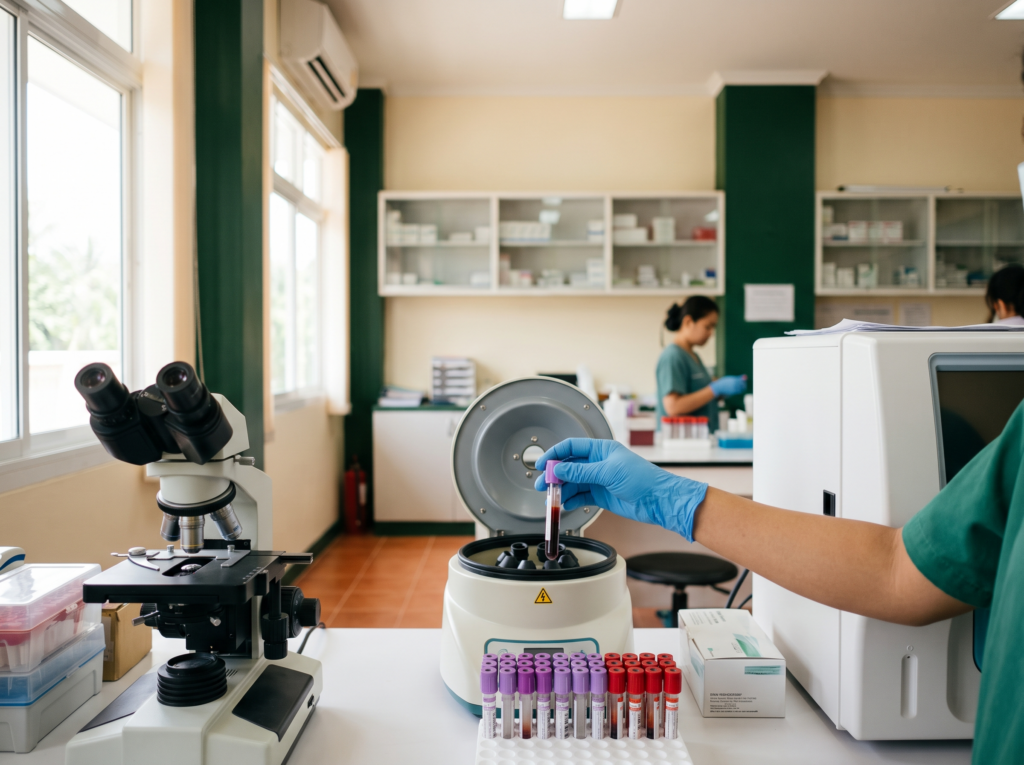
A blood test settles it, and there are two kinds. The NS1 antigen test detects the virus itself and works best in the first five days. Antibody tests, IgM and IgG, become useful from around day five onwards.
Come in too early and a negative can be misleading; come in on the wrong test for the day of illness and you learn less than you should. We use the day of onset to decide, which is why we ask when the fever started rather than when you decided to come in.
A full blood count matters just as much as the dengue test. Platelet count and haematocrit are what actually track the illness, and a falling platelet count with a rising haematocrit is the pattern that changes management — see blood tests.
No paracetamol substitutes here — the painkiller rule
This is the single most important thing on this page.
Take paracetamol only. No ibuprofen, no aspirin, no naproxen, no diclofenac, and none of the combination cold-and-flu sachets that quietly contain them. Anti-inflammatories affect platelets and raise the bleeding risk in an illness that is already lowering your platelet count.
People reach for ibuprofen precisely because the joint pain is so severe and paracetamol feels inadequate against it. That instinct is understandable and it is the wrong move. If the pain is not controlled, come in rather than escalating the painkiller yourself.
The critical phase, and why feeling better can mislead
Around day three to seven the fever drops. Most people read that as recovery. In a small proportion it is the start of the phase where plasma leaks from the blood vessels, and that is when dengue becomes dangerous.
Warning signs, all of which mean come in immediately at any hour:
- Severe abdominal pain or persistent vomiting
- Bleeding gums or nose, or blood in vomit or stool
- Black, tarry stools
- Restlessness, lethargy or confusion
- Cold, clammy skin, or a rapid weak pulse
- Difficulty breathing
- Not passing urine for many hours
The window in which this is easy to manage is measured in hours, and it usually opens on the day somebody has decided they are over the worst.
What treatment actually consists of
There is no antiviral for dengue. Treatment is supportive, and done properly it works: fluids, paracetamol, rest, and repeated blood counts to watch the trend rather than a single snapshot.
Fluids are the whole game. Most people with dengue cannot drink enough on their own, because they are nauseated and have no appetite while their fluid requirement has gone up. An IV drip is often the difference between managing this on the island and needing a hospital bed.
We recheck bloods daily during the risky window rather than testing once and sending you away. That is the part that catches the deterioration early, and it is the reason to be under someone’s eye rather than lying in a bungalow hoping.
When this needs the mainland
Most dengue is managed here. Some is not, and the decision is made on numbers rather than impressions: platelets falling steeply, haematocrit climbing, signs of plasma leakage, bleeding, or an inability to keep fluids in despite an IV.
On an island where the crossing to Krabi or Phuket takes around two hours and the boat schedule thins after dark, that decision has to be made earlier than it would be on the mainland. We would rather transfer somebody who turns out to be fine than start arranging a boat at three in the morning for somebody who is not — see emergency evacuation.
If you are travelling alone, tell us. Somebody with dengue needs a person checking on them, and that changes where we would rather you spend the next two nights.
Afterwards, and the second infection question
Recovery is slower than people expect. Profound tiredness for one to two weeks is normal, sometimes with low mood alongside it. The rash can itch as it fades. Diving is off until you are properly recovered rather than merely upright — talk to us before booking, and see dive medical.
There are four dengue serotypes. Recovering from one gives lasting immunity to that one only, and a later infection with a different serotype carries a higher risk of the severe form. This matters if you travel in the region regularly, and it is worth knowing rather than discovering.
Get an insurance-ready record before you leave. Dengue often means cancelled onward travel and rebooked flights, and claims go far more smoothly with dated test results — see travel insurance claims and medical certificates.
Frequently asked questions
How soon after a mosquito bite does dengue start?
Typically four to seven days, so the mosquito may have been somewhere else entirely, not on this island.
Can I take ibuprofen for the joint pain?
No. Paracetamol only. Ibuprofen, aspirin and similar drugs raise the bleeding risk in an illness that already lowers platelets.
What test do I need, and when?
NS1 antigen in the first five days, antibody tests from around day five. A full blood count matters just as much either way.
Why do I feel worse after the fever breaks?
The critical phase begins as the fever drops. That is when plasma leakage can start, and it is the time to be watched rather than relaxed.
Is there a cure for dengue?
No antiviral exists. Treatment is fluids, paracetamol, rest and repeated blood counts — done properly, that works.
Do I need to go to hospital?
Most cases are managed here. Falling platelets, rising haematocrit, bleeding or fluids that will not stay in mean a transfer, and that call is made early on an island.
Can I get dengue twice?
Yes. There are four serotypes, and a second infection with a different one carries a higher risk of the severe form.
How long until I feel normal again?
Expect one to two weeks of heavy tiredness after the fever has gone. Recovery is slower than most people plan for.
The island arithmetic, and where we fit in it
English-speaking doctors on site, 24 hours a day. It is worth spelling out why that matters rather than leaving it as a claim. Koh Phi Phi has no hospital, no road connection and no ambulance service. Getting to an emergency department means a boat, and the scheduled boats run in daylight — so for a good part of every twenty-four hours, the island’s own clinic is not the convenient option, it is the only one. Everything about how we are staffed follows from that single fact.
Beyond the island, Doctor Phi Phi Takecare Clinic belongs to the Takecare Clinic group, which operates across Krabi and Phuket. The practical value of that is continuity: if your treatment carries on after you leave, the next clinic already holds your notes, and a referral is a phone call between colleagues rather than a stack of paperwork you have to carry yourself.
Coming in
Doctor Phi Phi Takecare Clinic is 24 hours, every day, and that is the building being open with a doctor in it rather than a phone line that answers. No appointment is needed at any point, and there is no hour at which turning up is inconvenient for us. There are 2 branches on the island, about ten minutes apart on foot, and both keep the same hours — so head for whichever is closer rather than looking for the right one. Walk in, or reach us on +66 82 140 3858 or WhatsApp. If you would rather not move, ask for a doctor hotel visit and we will come to you.
If it turns out this is beyond what the island can treat, the same conversation is where the boat and the hospital transfer start being arranged. That process is worth beginning early rather than late here, because the options genuinely narrow as the evening goes on — and a decision made at nine is a considerably better decision than the same one made at two in the morning.