Getting off the island: emergency evacuation from Koh Phi Phi
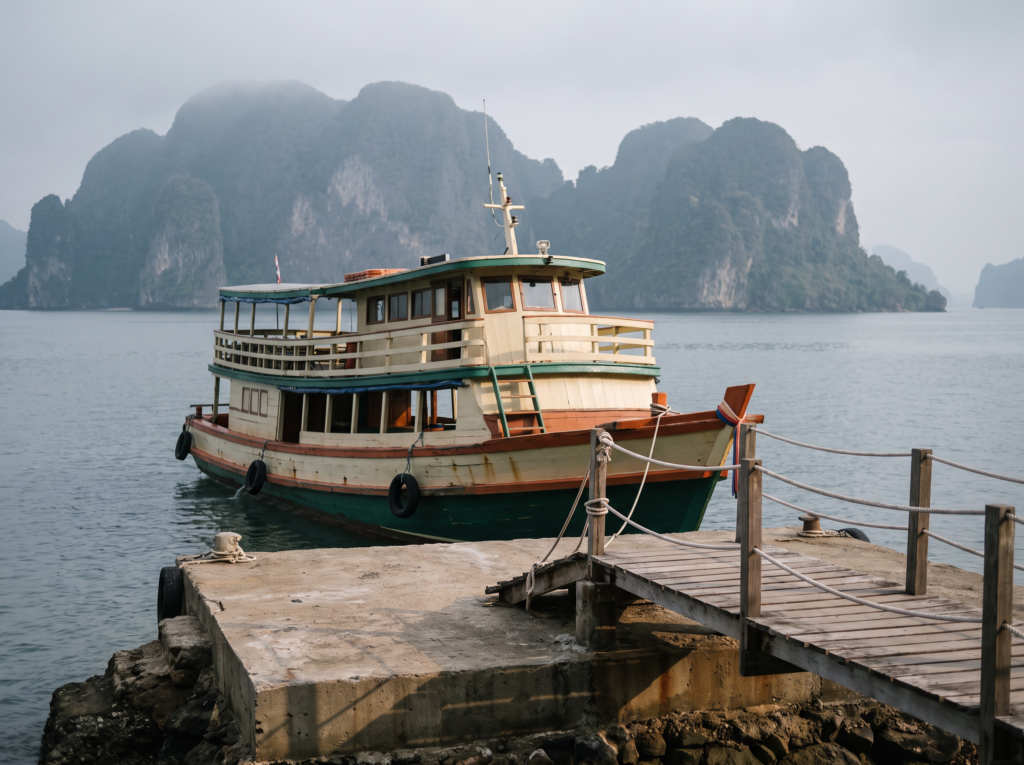
Getting a sick person off Koh Phi Phi is a logistics problem before it is a medical one. There is no hospital on the island, no road link and no ambulance access, so emergency evacuation in Koh Phi Phi means a boat to Krabi or Phuket, an ambulance meeting it, and a hospital expecting you. Those three things have to be arranged in parallel, and arranging them is a service we provide rather than a disclaimer we issue.
What the journey actually looks like
From the clinic to a hospital bed on the mainland is realistically two hours, and most of that is not medical.
A scheduled ferry to Krabi or Phuket takes around ninety minutes to two hours. A chartered speedboat cuts the water time to about forty-five minutes but costs considerably more. Then thirty to forty minutes by road at the far end, plus loading time at both piers.
Everybody underestimates the loading. Getting somebody who cannot weight-bear along a pier and onto a boat, then off again at the other end, is slow and awkward work, and it is where an unplanned evacuation loses most of its time. Knowing that in advance is why we start the boat call early rather than at the point you are ready to move.
When evacuation is the right decision
Anything needing an X-ray, a scan, an operation, a blood transfusion, an overnight bed or a recompression chamber. None of those exist on this island.
In practice that means suspected fractures, head injuries needing imaging, appendicitis and other surgical abdomens, serious dengue with falling platelets, chest pain, stroke symptoms, severe burns over a large area, and any suspected decompression illness after diving.
It also includes things that look entirely undramatic. Cellulitis spreading despite oral antibiotics is a boat ride, because the treatment is intravenous and runs for several days rather than hours.
What we do before you leave
The point of stopping here first is that you arrive already worked up rather than starting from zero in a queue.
We stabilise: oxygen if needed, an IV line so fluids and medication are already running, pain control adequate for a boat journey that will not be gentle, splinting for anything broken, and bleeding properly controlled rather than held.
We also do the paperwork that makes the receiving end faster — a written English summary of the findings, the observations, what was given and when, plus any blood test results run here. A Thai hospital receiving a foreign patient with no history and no shared language starts a long way behind, and that handover closes most of the gap before you arrive.
Krabi or Phuket, and how that gets decided
Both are roughly two hours away by scheduled boat, in opposite directions, and the right answer depends on what is wrong rather than on which is nearer.
Phuket has the larger private hospitals, more specialists and the recompression chamber, which makes it the destination for diving injuries, complex surgery and anything needing intensive care. Krabi is entirely capable for most emergencies and is closer to the rest of the clinic network.
For a genuine emergency we make that call on clinical grounds and tell you why. For anything less immediate we will explain the trade-off — cost, travel time, which your insurer prefers — and let you choose. That is a conversation worth having while you are still on the island rather than after you have landed somewhere.
Night crossings, weather and the limits of boats
Scheduled ferries run in daylight only. After dark, a crossing means chartering a private speedboat, which is available but expensive and weather-dependent.
In genuinely bad weather a crossing may not be possible at all for a period. That is the single strongest argument for calling early rather than watching a situation for a few more hours — a problem that would have crossed comfortably in the afternoon can become one that waits for dawn.
Monsoon season sharpens this considerably. Between roughly May and October the sea can close the option entirely for half a day at a time, and the decision to move somebody is best made while the option still exists rather than discovered to have expired.
Who pays, and when it gets asked
The boat and the ambulance are paid at the time. A scheduled ferry is trivial; a night speedboat charter is not, and you will be told the figure before it is booked rather than afterwards. Hospital costs on the mainland are separate and depend entirely on what you need.
Tell us about insurance at the beginning. Most travel policies cover emergency transfer, but many want notifying while it is happening rather than a claim afterwards, and some will only pay if they have approved the receiving hospital.
Making that call from the clinic while we prepare you is straightforward. Reconstructing it from a hospital bed three days later is not — see travel insurance claims. And if you have been diving, check the policy covers it, because a good number do not.
The part people are least prepared for
Who goes with you, and what happens to everybody else.
Somebody should travel with the patient, and it should be decided in the first few minutes rather than argued about on the pier. That person needs both passports, the insurance details, and enough money for a night on the mainland, because they may not be coming back the same day.
The rest of the group is then on an island with the patient’s luggage, an unclear plan and no way to follow until the morning boat. It is worth agreeing, before anybody leaves, who is handling the room, the bags and the phone. None of that is medical, and all of it goes wrong routinely.
What you can do to make it faster
Call early. That is genuinely the whole list, and it costs nothing.
Beyond that: have passports and insurance details together rather than scattered across a room, decide who is travelling, and tell somebody which property you are in so the boat and the doctor are not looking for you. If a friend can go ahead to the pier, that helps more than it sounds.
And do not start walking to the pier to save time. Call 1669 and call us at the same time, then move when there is something to move towards — see emergency care for what counts as an emergency, and doctor hotel visit if you cannot get to us at all.
Frequently asked questions
How long does it take to reach a hospital?
Realistically about two hours to a mainland hospital bed — ninety minutes to two hours on a scheduled boat, or around forty-five minutes by chartered speedboat, plus road time and loading at both ends.
Can a helicopter come to Koh Phi Phi?
Air evacuation exists in Thailand but is rare, expensive and weather-dependent, and generally needs insurer approval. For almost everybody the realistic route is boat and ambulance.
What happens after the last ferry?
A crossing means chartering a private speedboat. It is available at any hour but costs considerably more, and rough weather can rule it out entirely.
Krabi or Phuket?
Both are about two hours away. Phuket has the bigger private hospitals and the recompression chamber; Krabi is entirely capable for most emergencies. We decide on clinical grounds for a true emergency.
What does the boat cost?
A scheduled ferry is inexpensive. A night speedboat charter is not, and you are told the figure before it is booked.
Can my partner travel with me?
Yes, and somebody usually should. Bring both passports, the insurance details and enough money for a night on the mainland.
What about the rest of my group and our luggage?
Agree who is handling the room, the bags and the phone before anybody leaves. It is not medical and it goes wrong routinely.
Do you come with me on the boat?
For unstable patients, where possible. For stable transfers you travel with a written English handover for the receiving hospital.
The island arithmetic, and where we fit in it
English-speaking doctors on site, 24 hours a day. It is worth spelling out why that matters rather than leaving it as a claim. Koh Phi Phi has no hospital, no road connection and no ambulance service. Getting to an emergency department means a boat, and the scheduled boats run in daylight — so for a good part of every twenty-four hours, the island’s own clinic is not the convenient option, it is the only one. Everything about how we are staffed follows from that single fact.
Beyond the island, Doctor Phi Phi Takecare Clinic belongs to the Takecare Clinic group, which operates across Krabi and Phuket. The practical value of that is continuity: if your treatment carries on after you leave, the next clinic already holds your notes, and a referral is a phone call between colleagues rather than a stack of paperwork you have to carry yourself.
Coming in
Doctor Phi Phi Takecare Clinic is 24 hours, every day, and that is the building being open with a doctor in it rather than a phone line that answers. No appointment is needed at any point, and there is no hour at which turning up is inconvenient for us. There are 2 branches on the island, about ten minutes apart on foot, and both keep the same hours — so head for whichever is closer rather than looking for the right one. Walk in, or reach us on +66 82 140 3858 or WhatsApp. If you would rather not move, ask for a doctor hotel visit and we will come to you.
If it turns out this is beyond what the island can treat, the same conversation is where the boat and the hospital transfer start being arranged. That process is worth beginning early rather than late here, because the options genuinely narrow as the evening goes on — and a decision made at nine is a considerably better decision than the same one made at two in the morning.