Treating fire show burns on Koh Phi Phi
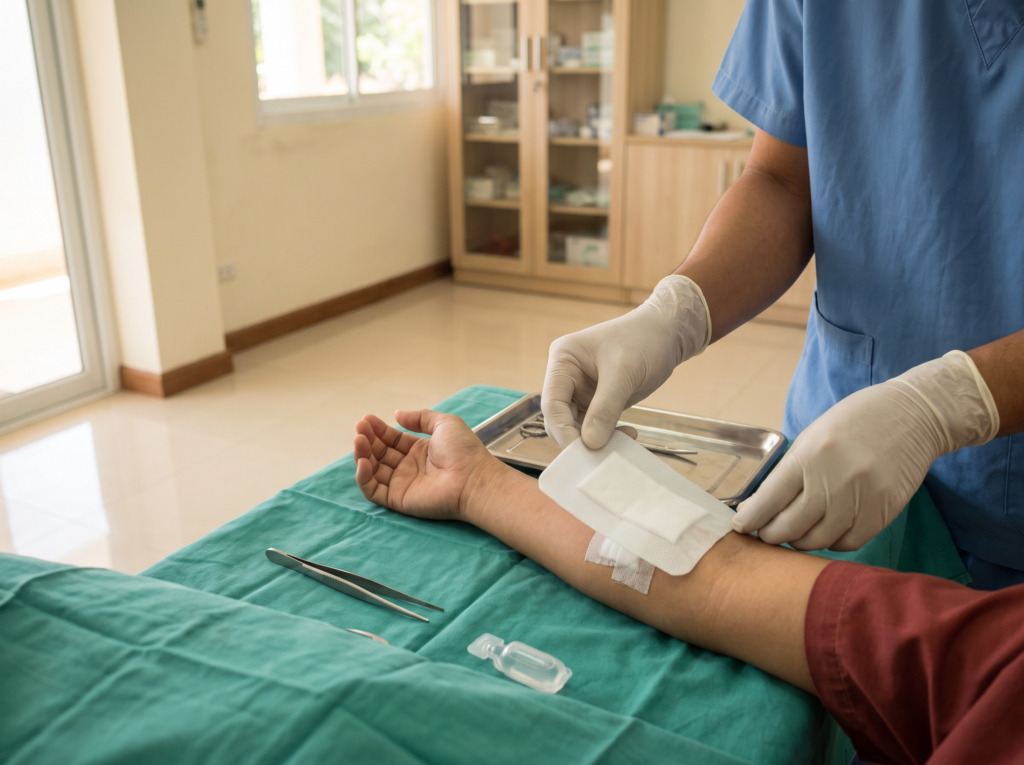
The fire shows on Ao Lo Dalum are part of what people come here for, and they produce a steady trickle of burns every night of the week. Skipping ropes, fire limbo, paraffin and bare skin. Fire show burn treatment in Koh Phi Phi is available at any hour, and the first twenty minutes after it happens matter more than anything done later.
Cool it for twenty minutes. That is the whole first step.
Cool running water, twenty minutes, starting as soon as possible. Not ice, not a bucket of sea water, not beer, and not for two minutes because it stings.
Twenty minutes sounds excessive and it is the single thing that most reduces how deep a burn ends up. Heat keeps damaging tissue after the flame is gone, and cooling stops that process rather than merely easing the pain. It is still worth doing up to three hours afterwards.
Then remove anything tight from the area — rings, watches, bracelets — before swelling starts. Leave anything stuck to the skin exactly where it is. Cover loosely with cling film or a clean non-fluffy cloth, and come in.
What not to put on it
No ice, which causes further injury to already damaged tissue. No butter, oil, toothpaste or aloe straight onto a fresh burn. No sea water and no sand.
Do not pop blisters. The roof is a sterile cover, and on this island opening it invites infection from bacteria that do very well in warm salt air.
And do not accept a bar’s first aid as the end of it. A wet towel and a shot is what usually gets offered, and neither is treatment for a burn that will still be there in a week.
Why these burns behave differently
Fire show burns are usually paraffin burns, and paraffin sticks. It continues burning against the skin after contact, which is why a glancing touch from a fire rope produces a deeper injury than the momentary contact suggests.
They also tend to land on the shins, forearms, hands, feet and back — thin-skinned areas over bone, where burns go deep quickly and heal slowly. Feet in particular, because most people are barefoot on the sand.
And they happen at night, to people who have been drinking, on a beach, followed by a swim and a few more hours out. That sequence — heat, salt water, sand, alcohol, delay — is why we take fire show burns more seriously than their size would suggest.
When a burn needs proper treatment
Come in without waiting for any of these:
- A burn larger than the palm of your hand
- Any burn to the face, hands, feet, genitals or across a joint
- A burn that goes all the way round a limb
- White, brown, leathery or charred skin
- A burn with no pain, which means the nerves are damaged
- Any blistering, rather than simple redness
- Any burn in a child
A painless burn is the one people under-rate, because they judge severity by how much it hurts. Full-thickness burns destroy the nerve endings, so the deepest injury is the one that does not hurt. See burn treatment for how the depth assessment works.
What we do
Cooling completed properly if that has not happened. Pain relief before anything else, because dressing a burn hurts and there is no reason to be stoic about it.
Cleaning, debridement of loose dead skin, and a specialist burn dressing — silver-based or hydrocolloid depending on depth and site — rather than gauze, which sticks and tears the healing surface off at the next change.
Then a tetanus check, and regular dressing changes every two or three days, which is where the outcome is actually decided. Burns on an island go wrong between visits, not during them — see wound dressing.
Infection, which is the real risk here
A burn is a large area of missing skin barrier in a hot, humid, salty environment. Infection is the complication that turns a two-week healing time into a month and a good scar into a bad one.
Watch for increasing pain after day two rather than decreasing, spreading redness beyond the burn edge, swelling, yellow or green discharge, an unpleasant smell, red streaks running up the limb, or fever. Red streaking and fever mean come in immediately at any hour — see cellulitis.
And keep it out of the sea. That is unwelcome advice on a diving holiday and it is not negotiable — sea water on an open burn is one of the reliable ways to end up needing antibiotics, and the marine bacteria involved are not the ones ordinary treatment assumes.
Scarring, and what actually affects it
Three things: how deep the burn was, whether it got infected, and whether the new skin was kept out of the sun.
The first is decided in the first twenty minutes by how well it was cooled. The second is decided by dressings and hygiene over the following fortnight. The third runs for a year, and it is the one people ignore — new skin over a burn pigments permanently if it is exposed, which on this island happens within days of the dressing coming off.
So: total sun block or covering over the site for months, not weeks. Silicone gel or sheets once healed. And do not pick at anything.
Getting seen, and the paperwork afterwards
Both branches are staffed around the clock, which is the point — fire shows finish long after everything else on the island has closed, and there is no reason to wait until morning with a fresh burn.
If you cannot get there, we come to you. A doctor hotel visit makes sense for anybody who cannot walk on a burned foot, which is a large share of these.
Get it documented from the first visit. Burns often mean cancelled dives, changed flights and a course of dressings, and insurers want the record made at the time — see travel insurance claims and medical certificates. Where a burn is extensive enough to need a hospital, we arrange the transfer through emergency evacuation.
Frequently asked questions
What should I do immediately after a fire show burn?
Cool running water for twenty full minutes. Not ice, not sea water, not beer. It is the single thing that most reduces how deep the burn ends up.
Can I put aloe or toothpaste on it?
No. Nothing goes on a fresh burn except cool water and then a loose clean covering or cling film.
Should I pop the blisters?
No. The blister roof is a sterile cover, and opening it in this climate invites infection.
Why does my burn not hurt?
That is a warning sign, not a good one. Full-thickness burns destroy the nerve endings, so the deepest burns hurt least.
Can I swim with a burn?
No. Sea water on an open burn is one of the reliable routes to infection, and marine bacteria need different antibiotics.
Are you open after the fire shows finish?
Yes, both branches, at any hour. That is exactly when these come in.
Will it scar?
Depends on depth, infection and sun. Cool it properly, keep it clean, and keep the new skin covered from the sun for months.
Do I need a tetanus shot?
We check. If your last booster was more than five years ago, or you are unsure, we give one.
The island arithmetic, and where we fit in it
English-speaking doctors on site, 24 hours a day. It is worth spelling out why that matters rather than leaving it as a claim. Koh Phi Phi has no hospital, no road connection and no ambulance service. Getting to an emergency department means a boat, and the scheduled boats run in daylight — so for a good part of every twenty-four hours, the island’s own clinic is not the convenient option, it is the only one. Everything about how we are staffed follows from that single fact.
Beyond the island, Doctor Phi Phi Takecare Clinic belongs to the Takecare Clinic group, which operates across Krabi and Phuket. The practical value of that is continuity: if your treatment carries on after you leave, the next clinic already holds your notes, and a referral is a phone call between colleagues rather than a stack of paperwork you have to carry yourself.
Coming in
Doctor Phi Phi Takecare Clinic is 24 hours, every day, and that is the building being open with a doctor in it rather than a phone line that answers. No appointment is needed at any point, and there is no hour at which turning up is inconvenient for us. There are 2 branches on the island, about ten minutes apart on foot, and both keep the same hours — so head for whichever is closer rather than looking for the right one. Walk in, or reach us on +66 82 140 3858 or WhatsApp. If you would rather not move, ask for a doctor hotel visit and we will come to you.
If it turns out this is beyond what the island can treat, the same conversation is where the boat and the hospital transfer start being arranged. That process is worth beginning early rather than late here, because the options genuinely narrow as the evening goes on — and a decision made at nine is a considerably better decision than the same one made at two in the morning.