Wound cleaning and dressing on Koh Phi Phi
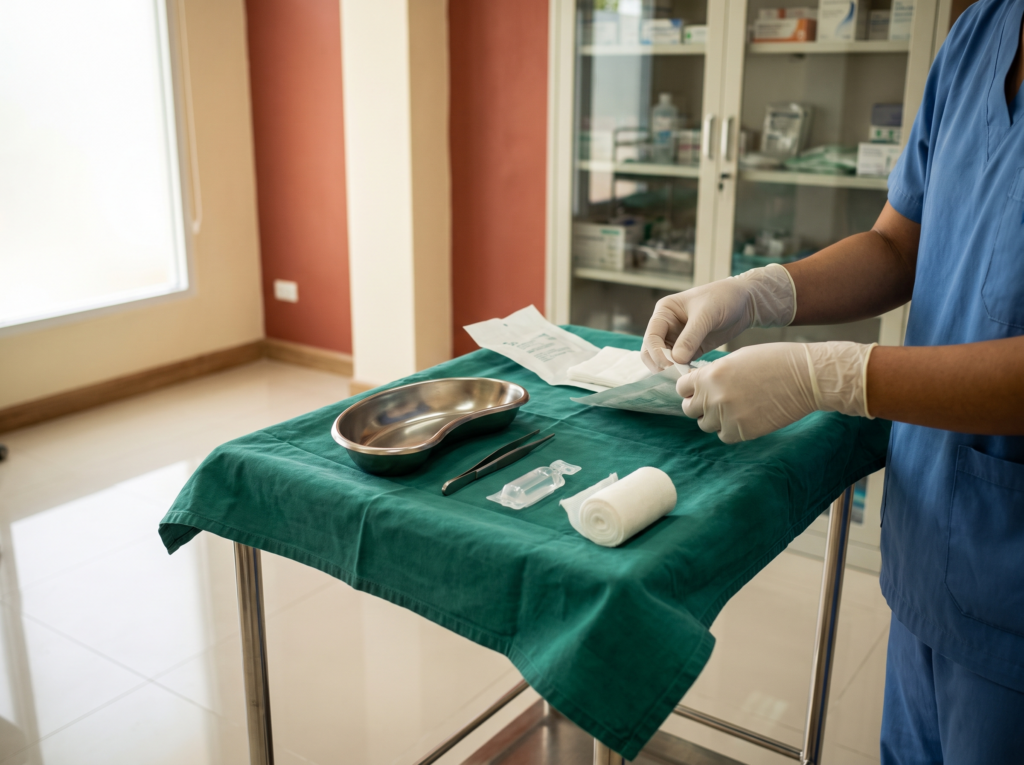
A wound that would heal without incident at home has a considerably harder time on a tropical island. Heat, humidity, seawater, sand and sweat all work against it, and what decides the outcome is usually not the original injury but what happens over the following week. Wound dressing in Koh Phi Phi is available at any hour, and you are welcome whether or not we treated the wound in the first place.
Why wounds behave badly here
Bacteria multiply faster in heat. Humidity keeps dressings damp, and a damp dressing stops being a barrier and becomes a culture medium instead. Sweat lifts adhesive, so tape that held for a day at home peels here by lunchtime.
Then there is the sea. Everybody swims, and warm coastal water carries organisms — including Vibrio species — that cause infections rarely seen in temperate countries and that move quickly once established.
The practical consequence is that the interval between dressing changes should be shorter here than you are used to, and the threshold for having somebody look at a wound should be lower. Both of those are cheap; the infection they prevent is not.
What a proper dressing change involves
Removing the old dressing without tearing new tissue, cleaning the wound rather than merely wiping the skin around it, inspecting the base for debris and signs of infection, and choosing a dressing that suits what the wound is doing now rather than what it was doing three days ago.
That last point is where most self-managed wounds go wrong. A wound that is oozing needs an absorbent dressing; the same wound four days later needs something that keeps it moist rather than drying it out. Using one dressing type throughout produces either maceration or a scab that cracks open every time you move.
Where a wound is deep or has a cavity, it needs packing rather than covering. A cavity closed at the surface with infection sealed inside is a predictable abscess — see minor surgery.
The signs that mean now rather than tomorrow
Come in the same day for any of these:
- Redness spreading outward from the wound edges
- Increasing pain after day two, when it should be easing
- Yellow or green discharge, or a smell
- Warmth and swelling around the area
- A red line tracking away from the wound
- Fever, chills, or feeling generally unwell
Spreading redness is the one to act on. It is cellulitis, it does not resolve on its own, and treated early it is oral antibiotics while treated late it means intravenous antibiotics on the mainland — a two-hour boat rather than a ten-minute walk.
Wounds we see most on this island
Coral and reef cuts, which look trivial and are the most reliably troublesome wounds here because of what gets left inside them.
Fire show burns, which need burn dressings rather than ordinary ones. Urchin spine punctures from wading at low tide. Cuts on boat propellers, cleats and rusted pier fittings. Grazes from falls on the viewpoint steps and the concrete paths behind the village, usually collected after dark.
And a steady number of wounds treated somewhere else that have simply not been looked at since — on the mainland, in another country, or by a well-meaning friend with a first aid kit. That is exactly what a daily dressing service is for.
Keeping a wound dry when everything is wet
The honest position is that a healing wound and daily swimming are not compatible, and most people would rather have a workable compromise than a rule they will ignore.
Waterproof dressings help but do not survive an hour in the sea; assume water gets in and change the dressing straight after swimming rather than at bedtime. Let it dry in the air overnight where the wound allows, because a night of drying does more good than another twelve hours under damp gauze.
Sand is worse than water. A wound that has had sand in it needs proper irrigation rather than a rinse, and that is worth walking in for at any hour rather than doing badly with a water bottle.
Tetanus, which people forget until it is mentioned
Any wound contaminated with soil, sand, rust or animal saliva raises the question of tetanus, and most travellers cannot remember their last booster.
Protection lasts about ten years. If you are outside that window, or genuinely do not know, having the booster is quick, inexpensive and settles it — see travel vaccinations.
If the wound came from an animal, tetanus is only half the question. The other half is rabies, and that clock starts immediately rather than tomorrow — see rabies vaccination.
Coming in, and what it costs
Dressing changes are inexpensive and need no appointment. Come in at any hour, at either branch, and somebody will see you.
If you were treated elsewhere, bring any paperwork you have and tell us what was used — particularly if you were given antibiotics and when they were started. That changes what we do next more than the appearance of the wound does.
If you cannot walk, dressings can be changed in your room as part of a doctor hotel visit, though for anything needing careful work the clinic’s light and sterile field give a better result.
Before you get on the boat
If you are leaving the island with an open wound, come in before you travel rather than after you land.
We will re-dress it for the journey, give you enough dressings to manage for a few days, and put the details in writing so whoever sees you next knows what was done and when. Ferry crossings here are wet, crowded and salty even in good weather, and spray reaches most seats on a rough day.
A dressing applied the morning you travel is worth considerably more than one applied two days earlier, and it costs a few minutes on the way to the pier.
Frequently asked questions
How often should a dressing be changed here?
More often than at home — usually daily, and immediately after it gets wet or sandy. Heat and humidity turn a damp dressing into a problem rather than a barrier.
Can you dress a wound you did not treat?
Yes, and it is a large part of what we do. Bring any paperwork and tell us what has been used so far.
How much does a dressing change cost?
It is one of the cheaper things we do, and you are told the price before it is done.
Can I swim with a wound?
While it is open, not really. Waterproof dressings do not survive the sea for long — assume water gets in and change the dressing straight afterwards.
How do I know it is infected?
Spreading redness, increasing pain after day two, discharge, a red line tracking away, or fever. Any of those means the same day rather than tomorrow.
Do I need a tetanus jab?
If your last booster was more than ten years ago, or you cannot remember, yes — particularly for wounds involving sand, soil, rust or animals.
Can I come in at night for a dressing change?
Yes. Both branches are staffed around the clock, so a dressing that has soaked through at midnight does not have to wait for morning.
I am flying home tomorrow with an open wound. What should I do?
Come in before you travel. We will re-dress it for the journey, give you spares, and write down what was done for whoever sees you next.
The island arithmetic, and where we fit in it
English-speaking doctors on site, 24 hours a day. It is worth spelling out why that matters rather than leaving it as a claim. Koh Phi Phi has no hospital, no road connection and no ambulance service. Getting to an emergency department means a boat, and the scheduled boats run in daylight — so for a good part of every twenty-four hours, the island’s own clinic is not the convenient option, it is the only one. Everything about how we are staffed follows from that single fact.
Beyond the island, Doctor Phi Phi Takecare Clinic belongs to the Takecare Clinic group, which operates across Krabi and Phuket. The practical value of that is continuity: if your treatment carries on after you leave, the next clinic already holds your notes, and a referral is a phone call between colleagues rather than a stack of paperwork you have to carry yourself.
Coming in
Doctor Phi Phi Takecare Clinic is 24 hours, every day, and that is the building being open with a doctor in it rather than a phone line that answers. No appointment is needed at any point, and there is no hour at which turning up is inconvenient for us. There are 2 branches on the island, about ten minutes apart on foot, and both keep the same hours — so head for whichever is closer rather than looking for the right one. Walk in, or reach us on +66 82 140 3858 or WhatsApp. If you would rather not move, ask for a doctor hotel visit and we will come to you.
If it turns out this is beyond what the island can treat, the same conversation is where the boat and the hospital transfer start being arranged. That process is worth beginning early rather than late here, because the options genuinely narrow as the evening goes on — and a decision made at nine is a considerably better decision than the same one made at two in the morning.