Travel vaccines available on Koh Phi Phi
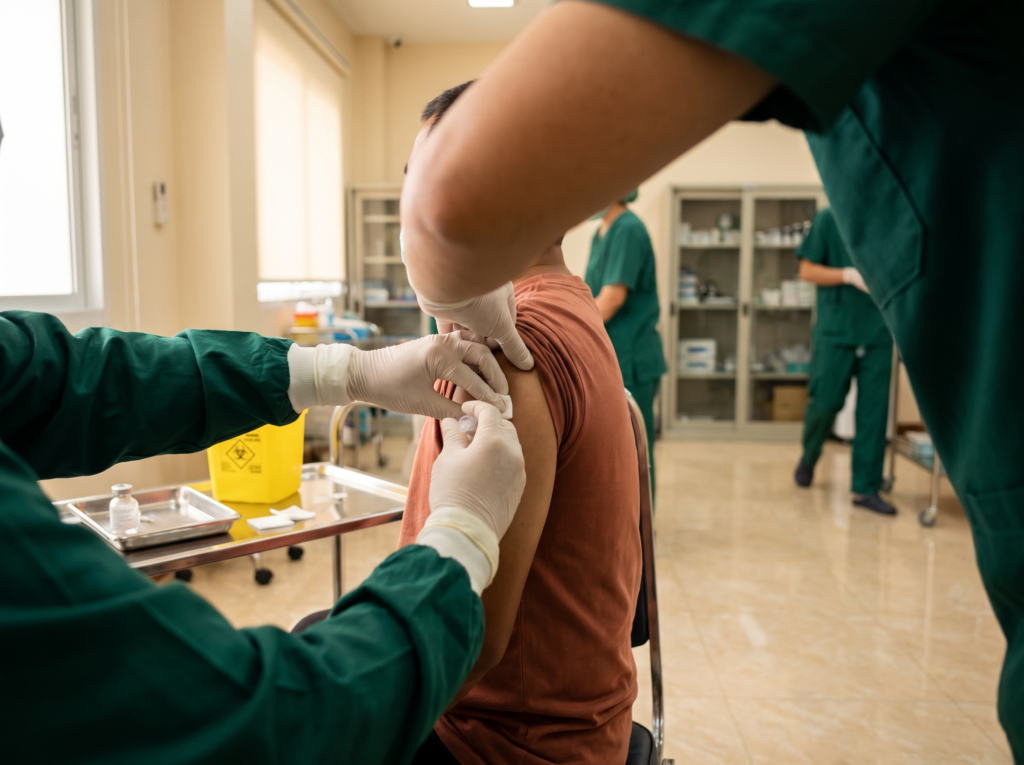
Most people arrive in Thailand having meant to sort out vaccinations and not quite managed it. That is recoverable rather than a disaster — nearly everything worth having can be started after you land. Travel vaccinations in Koh Phi Phi cover tetanus, hepatitis A and B, typhoid and influenza, given here without an appointment at any hour.
The one almost everybody needs
Tetanus. Cover lasts about ten years, and the great majority of travellers cannot say when they last had it.
It matters more here than at home because of what the wounds are made of. Coral and reef grazes, rusted pier fittings and boat cleats, animal bites, and falls on rock and concrete are exactly the contaminated puncture wounds tetanus thrives in, and this island produces all of them in volume.
If you are outside ten years or genuinely do not know, have the booster. Quick, inexpensive, and it removes a question that otherwise comes up urgently at the worst possible moment — usually at two in the morning with a wound that needs closing — see wound dressing.
Hepatitis A, the classic traveller infection
Hepatitis A spreads through contaminated food and water, which in practice means street food, ice, salads washed in tap water and shellfish. It is common across Southeast Asia and genuinely unpleasant — weeks of exhaustion and jaundice, occasionally months.
The vaccine is very effective and works fast enough to be worth having even after arrival. A single dose gives good protection for about a year; a second dose six to twelve months later extends it to roughly twenty-five.
If you are here for more than a few days and eating outside your hotel, which is most of the point of being in Thailand, this is the one to prioritise after tetanus.
Hepatitis B, and the tattoo question
Hepatitis B passes through blood and body fluids — sex, tattoos, piercings, and medical or dental procedures where sterilisation is uncertain. The course is three doses over six months, though an accelerated schedule exists if you are leaving sooner.
Tattoos deserve a specific mention on this island. There are a great many places offering them, a good number of customers have been drinking when they decide, and the combination of an impulsive decision and uncertain sterilisation is exactly the risk this vaccine covers.
If you are even considering one, have the first dose before rather than after. It is cheap, and the alternative is a blood test in three months and a wait.
Typhoid, influenza and what else is worth it
Typhoid is food and water borne, like hepatitis A, and worth having for longer trips or travel to rural areas. One injection gives about three years of protection. It is roughly 50 to 80 per cent effective rather than absolute, so it supplements food and water care rather than replacing it.
Influenza is worth more than people expect in the tropics. Transmission here does not follow the temperate winter pattern, it circulates year-round, and a boat full of people in an enclosed cabin is an efficient way to catch it.
Anybody working a season on this island should think about both, because a bad week off work is expensive and neither vaccine is.
Rabies, a different kind of decision
Pre-exposure rabies vaccination is worth genuine consideration here, specifically because of Monkey Beach and because the island has no immunoglobulin.
Having it in advance does not mean you can ignore a bite. It means the treatment afterwards is two doses instead of four, and — the part that matters here — no immunoglobulin, which is the component that requires a two-hour boat to the mainland to obtain.
If you are staying a season, working on the island, or travelling on to rural areas, it is a sensible investment. For a week’s holiday the more practical protection is simply not carrying food on Monkey Beach. Either way, read rabies vaccination before you need it, and animal bite treatment if you already do.
What is not a vaccine, and what to do instead
There is no vaccine against dengue available to most travellers, and dengue is the mosquito-borne illness you are actually likely to meet in Krabi province. Protection is repellent, covered skin at dawn and dusk, and air conditioning or a fan.
Malaria is not a meaningful risk on Phi Phi, in Krabi or in Phuket, and antimalarial tablets are not routinely recommended for this area. If you are travelling on to border regions that changes, and it is worth asking.
Japanese encephalitis is a consideration only for long rural stays, not for an island holiday. We will say so rather than sell it to you.
Timing, and the myth that it is too late
The frequent assumption is that vaccines given after arrival are pointless. That is wrong for almost everything on this list.
Hepatitis A produces useful protection within a couple of weeks and the disease has an incubation period of two to six weeks, so a dose in your first days of a longer trip is still doing real work. Tetanus boosters act quickly. Rabies pre-exposure is useful right up until the day something bites you.
The one thing that genuinely cannot be rushed is a full hepatitis B course, and even that has an accelerated schedule. Better late is not a slogan here, it is arithmetic.
What a visit involves and what it costs
Walk in at either branch, at any hour. We go through what you have already had, where you are going, how long you are staying and what you are doing, and recommend accordingly rather than selling you the full list.
Each vaccine is priced individually and quoted before anything is given. You get a written record with dates and product names, which you need if you are continuing a course elsewhere.
Injections go into the upper arm and ache mildly for a day. If you are diving tomorrow, have it in the arm you mind less — the ache is harmless but a sore shoulder under a BCD strap is a nuisance. See dive medical if you also need clearance to dive.
Frequently asked questions
Is it too late to get vaccinated after I have arrived?
For almost everything on this list, no. Hepatitis A, tetanus and rabies pre-exposure are all still worth having once you are here.
Do I need a yellow fever certificate for Thailand?
Only if you are arriving from a country where yellow fever is present. Coming from Europe, North America or Australia, no.
Is there a dengue vaccine?
Not one available to most travellers. Protection is repellent, covering up at dawn and dusk, and avoiding bites in the first place.
Do I need malaria tablets for Koh Phi Phi?
No. Malaria is not a meaningful risk here or anywhere in Krabi and Phuket. Border regions are a different question.
Should I get hepatitis B before a tattoo?
If you are considering one, yes. Uncertain sterilisation plus an impulsive decision is exactly the risk it covers.
How much do vaccinations cost?
Each is priced separately and quoted before it is given, so you know the total before agreeing to anything.
Can I dive after an injection?
Yes, though the arm aches for a day. Have it in the arm you mind less if you are diving tomorrow.
Can I get vaccinated at night?
Yes. Both branches are staffed around the clock, though for a planned course daytime is easier if you want to talk it through unhurried.
The island arithmetic, and where we fit in it
English-speaking doctors on site, 24 hours a day. It is worth spelling out why that matters rather than leaving it as a claim. Koh Phi Phi has no hospital, no road connection and no ambulance service. Getting to an emergency department means a boat, and the scheduled boats run in daylight — so for a good part of every twenty-four hours, the island’s own clinic is not the convenient option, it is the only one. Everything about how we are staffed follows from that single fact.
Beyond the island, Doctor Phi Phi Takecare Clinic belongs to the Takecare Clinic group, which operates across Krabi and Phuket. The practical value of that is continuity: if your treatment carries on after you leave, the next clinic already holds your notes, and a referral is a phone call between colleagues rather than a stack of paperwork you have to carry yourself.
Coming in
Doctor Phi Phi Takecare Clinic is 24 hours, every day, and that is the building being open with a doctor in it rather than a phone line that answers. No appointment is needed at any point, and there is no hour at which turning up is inconvenient for us. There are 2 branches on the island, about ten minutes apart on foot, and both keep the same hours — so head for whichever is closer rather than looking for the right one. Walk in, or reach us on +66 82 140 3858 or WhatsApp. If you would rather not move, ask for a doctor hotel visit and we will come to you.
If it turns out this is beyond what the island can treat, the same conversation is where the boat and the hospital transfer start being arranged. That process is worth beginning early rather than late here, because the options genuinely narrow as the evening goes on — and a decision made at nine is a considerably better decision than the same one made at two in the morning.