A doctor to your hotel or resort on Koh Phi Phi
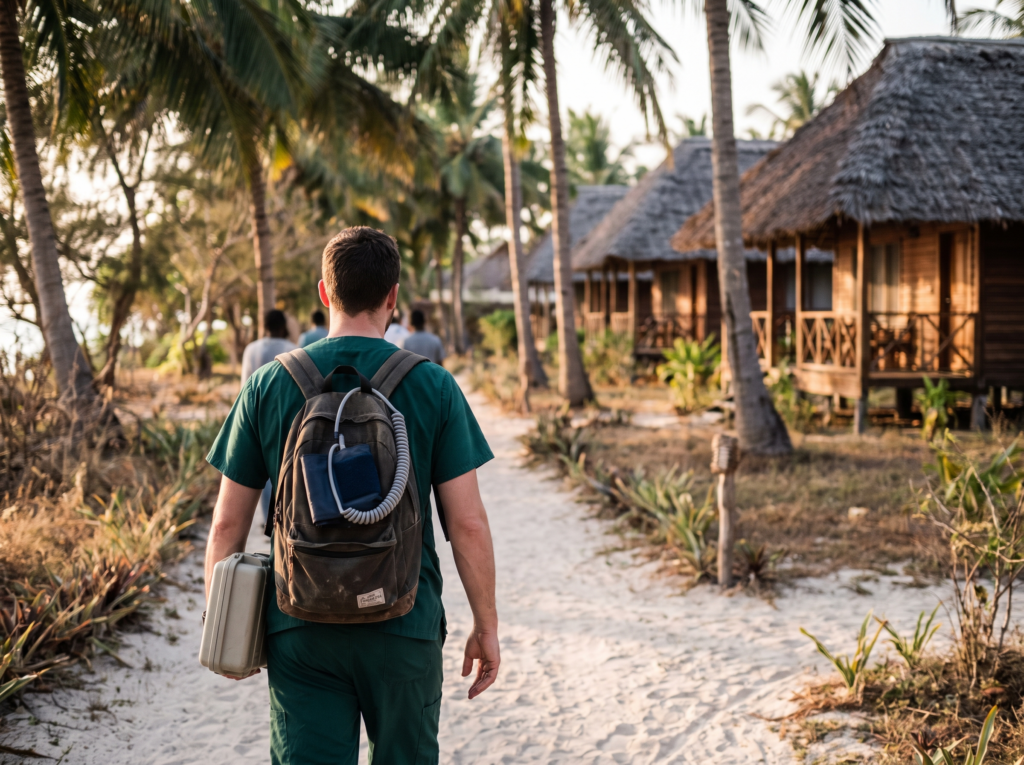
Koh Phi Phi has no cars, no taxis and no motorbikes for hire. Every journey on this island is walked, along sand and narrow alleys, and if you cannot walk you genuinely cannot get anywhere. A doctor hotel visit in Koh Phi Phi is a practical necessity here rather than a premium extra — a doctor comes to your room on foot, at any hour, usually within about half an hour.
Where we come to
Tonsai Village and the whole strip behind it, Loh Dalum Bay, and the hotels and hostels between the two. All of it is a straightforward walk and the doctor arrives on foot with a bag.
Long Beach and the more distant resorts take longer, and depending on the tide and the hour the doctor may come by boat rather than along the path. Tell us which beach and which property when you call, because that decides how the journey is made and how long it takes.
We also visit staff accommodation behind the bars and dive shops, which people working a season here often assume we do not. If you work on this island, this applies to you exactly as it does to guests.
When a visit is the right call
When walking is the problem. A twisted ankle on an island with no transport turns a ten-minute trip into an impossible one, and the walk itself can make the injury worse.
When you are too unwell to be upright — a high fever, relentless vomiting, food poisoning or heat exhaustion that has flattened you.
When somebody has drunk far more than they can handle and needs assessing where they are rather than being walked through Tonsai — see alcohol poisoning. When it is a child who would be far better off in a familiar room. And when there is a reasonable chance of something contagious, in which case staying put is better for everybody in the hostel.
What the doctor brings
Enough to finish most things on the spot: examination equipment, IV fluids and a stand, injectable anti-nausea and pain medication, antibiotics and other common prescriptions, wound cleaning and dressing kit, and rapid tests including dengue.
Most visits end at your room. Where they do not, it is because something needs the clinic — a wound requiring proper light and a sterile field, or blood tests beyond the rapid ones. You will be told why rather than simply told to come in.
Hostel and bungalow rooms are a genuine constraint on what can be done well. Dim light, no clear surface and a soft bed make careful wound work harder than it needs to be, and a repair done badly in poor light leaves a scar you keep for life. For anything more than a simple dressing the walk is usually worth it, and if you cannot manage the walk we would rather bring you in than do a compromised job on a hostel floor.
What it costs
There is a visit fee on top of the treatment, and you are told both before anybody sets off. It is not calculated afterwards based on how the visit went.
Late-night visits cost more than daytime ones, and you will be told that when you call rather than discovering it on the bill. The clinic itself is open all night at the same price as during the day, so if you can walk, walking is cheaper.
You get the same itemised receipt and English medical report as a clinic visit, which is what your insurer will ask for. Mention insurance when you call rather than when the doctor is leaving — see travel insurance claims.
How to ask for one
Call or message and say four things: which beach or which part of the village, the property name, the room number, and what has happened.
If there is any doubt about whether a visit or coming in suits you better, describe the problem and let us make that call. It is a thirty-second conversation that regularly saves somebody a painful walk, and occasionally saves them a considerably worse decision.
Have somebody meet the doctor at reception if the property is hard to find. A great many places here are up unlit stairs, behind other buildings, or signposted only in Thai, and it is by far the commonest cause of a slow arrival — more so than distance.
What to do while you wait
Get the person somewhere cool and, if they have been drinking, on their side rather than on their back. Somebody unconscious or barely rousable should never be left face-up, and never left alone.
Keep fluids going in small sips rather than large glasses if there is vomiting. Leave any wound covered rather than repeatedly uncovering it to look at it.
Write down when the symptoms started and what has already been taken, including anything bought over a counter and anything drunk. That last detail changes prescribing more often than people expect, and it is the thing nobody can recall accurately once the doctor is standing in the room.
Two branches, and which one comes
There are two clinics on the island, and the visit comes from whichever is closer to you or has a doctor free. You do not need to specify, and it does not change the fee.
What it does mean in practice is that a visit is rarely refused for lack of cover. With two sites staffed around the clock, somebody being out on a visit does not leave the island uncovered — which is the usual reason a single small clinic has to tell you to come in instead.
If you would rather come in yourself, either branch takes walk-ins at any hour. Both are on the walk-in clinic page with map links.
When to call an ambulance instead
A hotel visit is the wrong choice for anything time-critical. Chest pain, breathlessness at rest, stroke symptoms, a serious head injury, uncontrolled bleeding, a seizure, a near-drowning, or anybody who cannot be roused needs 1669 and a call to us at the same time — not a doctor walking over.
The reason is arithmetic rather than caution: those cases are going to hospital regardless, so the useful thing is to start the boat and the mainland end immediately rather than adding a walk to the front of the sequence.
The same applies to any suspected diving injury. See evacuation and hospital transfer and emergency care.
Frequently asked questions
How quickly can a doctor arrive?
Usually around thirty minutes for Tonsai Village and Loh Dalum. Long Beach and the outlying resorts take longer and may involve a boat.
Do you visit in the middle of the night?
Yes. The clinic is staffed twenty-four hours and visits run at any hour. Late-night visits cost more, and you are told the price when you call.
How much does a hotel visit cost?
A visit fee plus the cost of treatment, both quoted before the doctor sets off.
Can you treat children at the hotel?
Yes, and for a miserable child it is often the better option. Have their approximate weight ready for dosing.
My friend is very drunk and I am worried. Is that worth a call?
Yes, and it is a call we would much rather take than not. Keep them on their side, do not leave them alone, and let us assess them where they are.
Which branch does the doctor come from?
Whichever is closer or has a doctor free. You do not need to specify and it does not change the fee.
What if I need something you cannot bring?
You will be told during the visit and, if needed, brought to the clinic — or across to the mainland if it is beyond what the island can handle.
Will I get paperwork for my insurer?
Yes — an itemised receipt and an English medical report, exactly as for a clinic visit.
The island arithmetic, and where we fit in it
English-speaking doctors on site, 24 hours a day. It is worth spelling out why that matters rather than leaving it as a claim. Koh Phi Phi has no hospital, no road connection and no ambulance service. Getting to an emergency department means a boat, and the scheduled boats run in daylight — so for a good part of every twenty-four hours, the island’s own clinic is not the convenient option, it is the only one. Everything about how we are staffed follows from that single fact.
Beyond the island, Doctor Phi Phi Takecare Clinic belongs to the Takecare Clinic group, which operates across Krabi and Phuket. The practical value of that is continuity: if your treatment carries on after you leave, the next clinic already holds your notes, and a referral is a phone call between colleagues rather than a stack of paperwork you have to carry yourself.
Coming in
Doctor Phi Phi Takecare Clinic is 24 hours, every day, and that is the building being open with a doctor in it rather than a phone line that answers. No appointment is needed at any point, and there is no hour at which turning up is inconvenient for us. There are 2 branches on the island, about ten minutes apart on foot, and both keep the same hours — so head for whichever is closer rather than looking for the right one. Walk in, or reach us on +66 82 140 3858 or WhatsApp. If you are well enough to travel, you are also welcome to walk in to the clinic at any hour.
If it turns out this is beyond what the island can treat, the same conversation is where the boat and the hospital transfer start being arranged. That process is worth beginning early rather than late here, because the options genuinely narrow as the evening goes on — and a decision made at nine is a considerably better decision than the same one made at two in the morning.