24-hour walk-in medical clinic on Koh Phi Phi
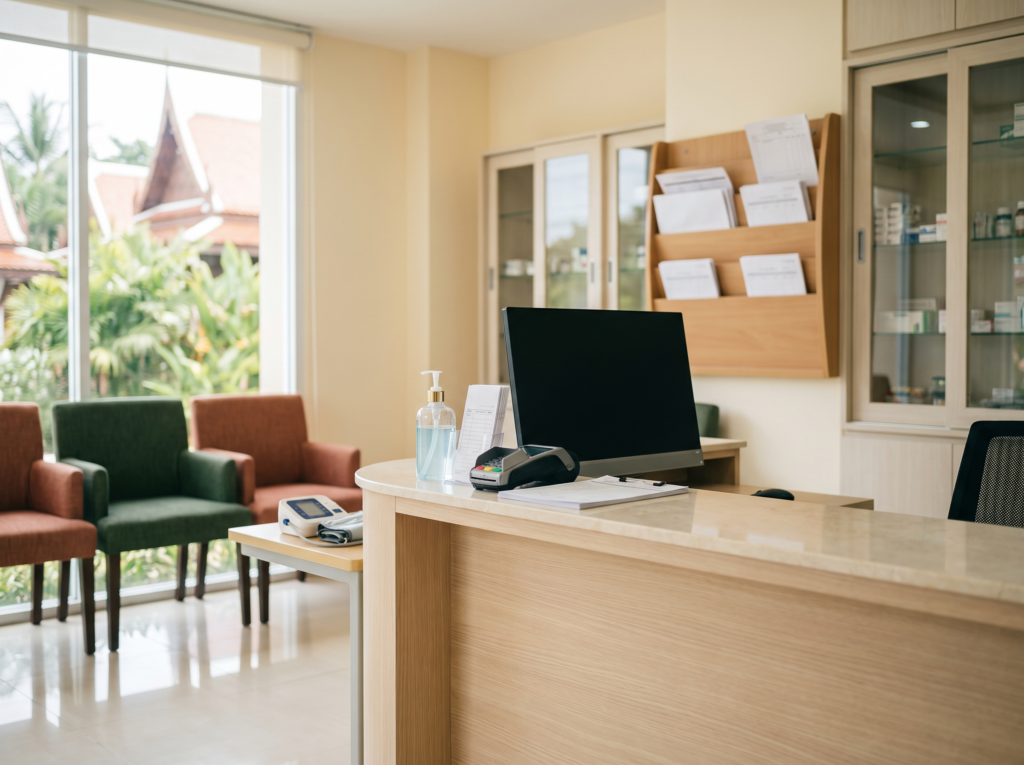
Koh Phi Phi has no hospital, no roads and no ambulance. Everything arrives and leaves by boat, and the scheduled boats run in daylight. That single set of facts is why a walk-in clinic in Koh Phi Phi is not a convenience here but the whole of the island’s medical provision for a large part of every day — and why this one is open at every hour, without appointments.
What walking in involves
Turn up. Any hour, any day, including Thai public holidays. There is no triage desk, no booking system to understand, and no form to complete before somebody looks at you.
Bring your passport if it is to hand, though you will be treated without it. If you take regular medication, bring the box rather than trying to recall the name — Thai brand names differ from the ones you know, and the box removes the guesswork in seconds.
If you are bringing a child, know their rough weight. Nearly every paediatric dose is calculated by weight, and a decent estimate saves a lot of back and forth at three in the morning.
And if you have been diving, say so and say when, along with how many dives and how deep. It changes what we look for on a whole range of complaints, and it is the detail people leave out because they cannot see the connection.
Why the overnight hours are the point
Most of what happens on this island happens after dark. The bars along Loh Dalum run late, the fire shows run later, and the last scheduled boat to the mainland has long gone by the time anybody gets hurt.
At two in the morning the realistic options are a clinic that is open or waiting until the first boat. Waiting is not a neutral choice: a wound left eight hours in this climate is a materially different wound, a fire show burn left overnight blisters and infects, and somebody who has drunk far too much is safest where they can be watched rather than in a hostel bunk.
There is also a category of treatment that runs on a clock of its own. Rabies vaccination after a monkey bite and PEP after a possible HIV exposure both work better the sooner they start, and PEP has a hard cut-off at seventy-two hours. Losing ten of those hours to nothing but the hour of the day is a bad trade.
Two branches, ten minutes apart
There are two clinics on the island rather than one, both keeping the same hours and both taking walk-ins on the same phone number.
Head for whichever is closer rather than trying to work out which is the right one. If you genuinely cannot tell — because you are helping somebody unsteady through unlit alleys at two in the morning — call and we will tell you, which takes about fifteen seconds.
Addresses, map links and directions for both are on the clinic contact page. On an island with almost no usable street addressing, the map pin is worth more than the postal address.
The things that come through the door most
In rough order of frequency: cuts and grazes, coral cuts from the reef, sea urchin spines picked up wading at low tide, and ear infections after several consecutive days of diving.
Then the ones that belong to this island specifically: burns from fire ropes and poi, alcohol poisoning from buckets that are considerably stronger than they taste, and monkey bites from the boat trips to Monkey Beach.
Alongside all of that, a steady stream of entirely ordinary things — stomach upsets, fevers that need a dengue test rather than a paracetamol and optimism, dressings that need changing, and stitches out on schedule.
What we can finish in one visit
Most problems open and close in the same visit. We clean and close wounds with stitches or glue, run blood tests with results while you wait rather than the next day, put up an IV drip for anybody who cannot keep fluids down, remove foreign bodies under local anaesthetic, and start rabies vaccination immediately after an animal bite.
Same-visit blood results matter more on an island than they would anywhere with a road. “Come back tomorrow for the result” here means either a wasted day of a short trip or a boat, and the interval between day three and day five of dengue is precisely when things either settle or do not.
We also handle the unglamorous work that keeps small problems small: daily dressing changes without an appointment, prescription refills for medication lost or soaked on a boat, and certificates for dive courses and airlines.
What it costs, and when you are told
A basic consultation is inexpensive. Anything beyond it is priced and quoted to you before it happens, so there is no moment at the end where the number is a surprise.
Payment is at the end of the visit by cash or card. You leave with an itemised receipt and an English medical report, which between them are what nearly every travel insurer asks to see.
Say the word insurance at the start rather than the end. It changes what gets documented while you are still in the room, and chasing paperwork after you have flown home is considerably harder than printing it now. If you dive, read travel insurance claims before you book a course rather than after an incident — a great many policies exclude scuba diving outright.
When to call rather than walk
Some things should not walk anywhere. Chest pain, breathlessness at rest, stroke symptoms, a head injury with vomiting or confusion, uncontrolled bleeding, a seizure, a near-drowning, or anybody who cannot be woken: call 1669 and call us at the same time.
Two calls in parallel beats two in sequence. There is no ambulance on this island, so somebody has to arrange the boat while the mainland end is organised, and those things happen simultaneously rather than one after the other — see evacuation and hospital transfer.
Any breathing difficulty, chest pain, confusion, weakness or unusual fatigue after diving is treated as a diving emergency until proved otherwise, and needs oxygen immediately rather than a night’s sleep — see dive medical.
The other case is simply being unable to travel. If getting here is the actual problem, do not attempt it; ask for a doctor hotel visit instead.
Finding us on an island with no addresses
Phi Phi has almost no usable street addressing and no vehicles beyond a handful of service carts. Everything is walked, through alleys that look similar in daylight and considerably more similar after dark.
The practical answer is the map pin rather than the address, plus asking as you go — every bar, dive shop and hotel reception in the village knows where both clinics are.
One thing worth doing on your first day rather than your worst one: save the number in your phone and drop both map pins into whatever you use for directions. It takes a minute while you are sober and rested, and it removes the part of a bad night that goes wrong most often — a group of people in an alley at three in the morning, phones flat, trying to work out where to go.
Frequently asked questions
Are you really open in the middle of the night?
Yes. Every hour of every day, including Thai public holidays. On an island where the boats stop at dusk, that is the reason the clinic exists in this form.
Do I need an appointment?
No, and there is no appointment system to opt into. Turn up whenever.
Which of the two branches should I go to?
Whichever is closer. Both keep the same hours and take walk-ins on the same number. If you are unsure, call and we will tell you.
How much does a consultation cost?
A basic consultation is inexpensive, and anything beyond it is quoted before it is done. You will not be handed an unexpected number at the end.
Do you speak English?
Yes. Almost all of our patients are visitors rather than Thai residents, and the doctors here work in English all day.
Can I be treated without my passport?
Yes. Bring it if it is easy, but nobody is turned away for not having it.
Can somebody come to my hotel instead?
Yes — ask for a doctor hotel visit. On an island where every journey is on foot, being unable to walk is a genuine obstacle rather than an inconvenience.
What if I need something you cannot do here?
We stabilise you, call ahead so the receiving hospital is expecting you, and arrange the boat and the ambulance so they connect. That is evacuation and hospital transfer.
The island arithmetic, and where we fit in it
English-speaking doctors on site, 24 hours a day. It is worth spelling out why that matters rather than leaving it as a claim. Koh Phi Phi has no hospital, no road connection and no ambulance service. Getting to an emergency department means a boat, and the scheduled boats run in daylight — so for a good part of every twenty-four hours, the island’s own clinic is not the convenient option, it is the only one. Everything about how we are staffed follows from that single fact.
Beyond the island, Doctor Phi Phi Takecare Clinic belongs to the Takecare Clinic group, which operates across Krabi and Phuket. The practical value of that is continuity: if your treatment carries on after you leave, the next clinic already holds your notes, and a referral is a phone call between colleagues rather than a stack of paperwork you have to carry yourself.
Coming in
Doctor Phi Phi Takecare Clinic is 24 hours, every day, and that is the building being open with a doctor in it rather than a phone line that answers. No appointment is needed at any point, and there is no hour at which turning up is inconvenient for us. There are 2 branches on the island, about ten minutes apart on foot, and both keep the same hours — so head for whichever is closer rather than looking for the right one. Walk in, or reach us on +66 82 140 3858 or WhatsApp. If you would rather not move, ask for a doctor hotel visit and we will come to you.
If it turns out this is beyond what the island can treat, the same conversation is where the boat and the hospital transfer start being arranged. That process is worth beginning early rather than late here, because the options genuinely narrow as the evening goes on — and a decision made at nine is a considerably better decision than the same one made at two in the morning.