Stitches for cuts on Koh Phi Phi
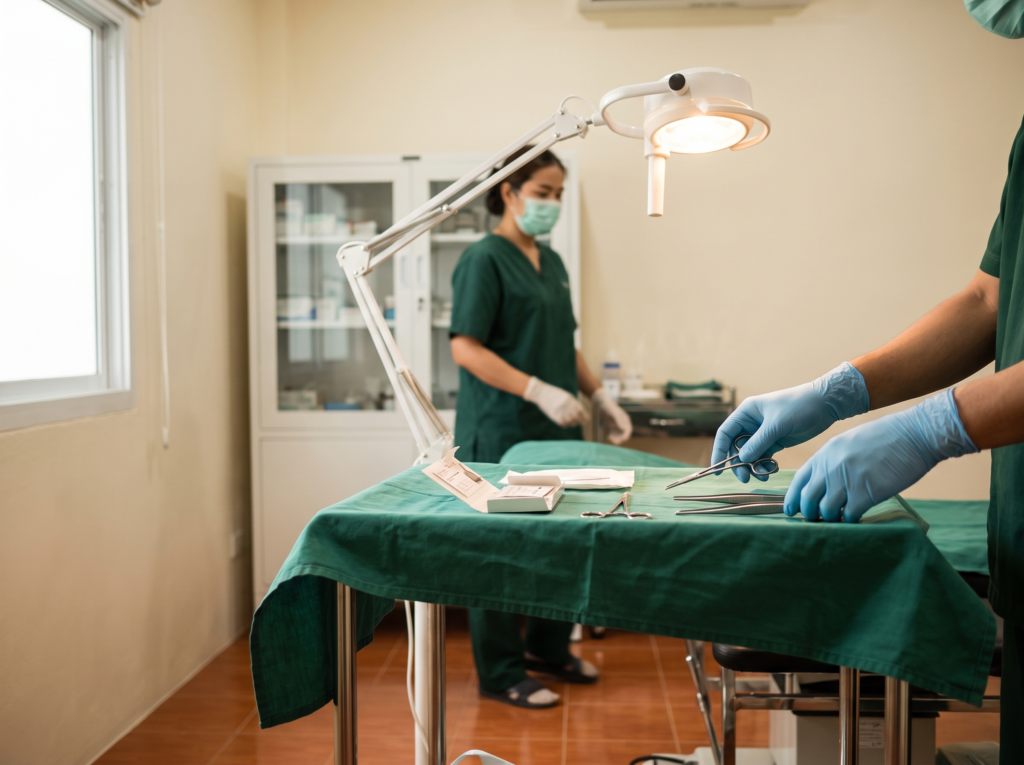
A cut that gapes when you relax the skin around it will not close neatly on its own. It heals slowly from the bottom up, leaves a wide scar, and in this heat it has a long time to become infected while doing so. Stitches in Koh Phi Phi are available at any hour without an appointment, and the timing matters considerably more than most people realise.
Which cuts need closing
The test is not length, it is whether the edges stay together. A cut that pulls apart when you move the surrounding skin needs help; one that sits closed does not.
Beyond that: anything deeper than the full thickness of skin, anything where you can see fat or deeper tissue, anything across a joint or a knuckle where movement will repeatedly pull it open, and anything on the face where the scar will be visible for the rest of your life.
Cuts that are shallow, short and already sitting closed do better cleaned and dressed than stitched. Closing a wound that did not need it adds two puncture holes per stitch for no benefit, and we will tell you when that is the case rather than reaching for a needle because you came in expecting one.
Why the first few hours matter
Wounds are best closed within about six to eight hours, and in tropical heat the earlier end of that is better. Past roughly twelve hours the bacterial load in a wound is high enough that sealing it shut can trap an infection inside.
An older wound still gets treated — the approach simply changes. Thorough cleaning, sometimes deliberately leaving it open to drain, sometimes closing it loosely, occasionally antibiotics alongside.
The practical version, and the reason both branches are staffed all night: a cut at one in the morning should be seen at one in the morning, not when you wake up. Waiting until daylight is the single commonest reason a straightforward repair becomes a complicated one, and on this island it used to be the only option.
Stitches, glue or strips
Not everything needs a needle, and the choice follows what the wound is doing rather than habit.
Tissue glue suits short, clean, straight cuts under no tension — quick, painless, and popular with children, but it fails on anything that moves or gapes. Adhesive strips suit shallow cuts whose edges already sit together. Stitches are for anything gaping, deep, over a joint, bleeding persistently, or on the face where alignment needs to be exact.
Glue and strips both come off in water, which on this island is a practical consideration rather than a footnote. If you cannot realistically stay out of the sea, that pushes the decision towards stitches even for a wound glue would otherwise hold.
What the repair actually involves
Local anaesthetic first, which is the part people dread and which stings for a few seconds before the area goes numb. Everything after that is pressure and movement rather than pain.
Then cleaning, which is the step that determines the outcome. The wound is irrigated properly and any grit, sand or coral fragment removed — beach sand and reef debris are the usual culprits here, and anything left behind becomes either an infection or a permanent grey tattoo of the injury.
Then closure with the finest suture material appropriate to the site, and a dressing. Most repairs take fifteen to thirty minutes end to end. You leave with instructions, a removal date, and an itemised receipt and English report for your insurer.
Alcohol, and why we ask
A good share of the cuts we repair arrive with somebody who has been drinking, and that changes several practical things rather than any judgement about it.
Alcohol dilates blood vessels, so wounds bleed more freely and need firmer pressure. It masks pain, which means people underestimate how deep a cut is and sometimes do not notice a second injury at all. It makes lying still for a repair harder, and it interacts with some pain relief.
So tell us honestly what you have had. It is not recorded to embarrass anybody — it changes how much local anaesthetic is used, which painkillers are safe to send you away with, and whether we would rather keep an eye on you for an hour before you walk home through unlit alleys.
The cut nobody mentions
Ask, always, whether the person fell. Somebody who has been drinking and has a cut on the head or face has usually fallen to get it, and a fall is a different conversation from a laceration.
Head injury and heavy intoxication look almost identical from the outside — drowsiness, confusion, unsteadiness, vomiting. That overlap is why we would rather observe somebody for an hour than close a scalp wound and send them into the night.
If somebody who was improving becomes drowsier again, that is a warning sign rather than tiredness catching up. Bring them back, or call — see alcohol poisoning and emergency care.
Keeping it intact for the next week
Keep it dry for the first forty-eight hours, which on Phi Phi means deciding not to swim rather than intending not to.
After that, brief contact with clean fresh water is tolerable if you dry it properly straight afterwards. Seawater and pool water are not — the sea here carries organisms that cause genuine trouble in a fresh wound.
Do not pick at it, do not apply antiseptic repeatedly to a healing wound, and come back if it becomes more painful after day two rather than less. See wound dressing for daily changes, which we do whether or not we put the stitches in.
When they come out, and the other two questions
Face: five days, because leaving them longer leaves stitch marks. Scalp, arms and trunk: seven to ten days. Hands and anywhere across a joint: ten to fourteen days, because those sites are under constant tension — see suture removal.
Any cut involving sand, soil, rust or seawater raises tetanus. Cover lasts about ten years and most travellers cannot date their last one — see travel vaccinations.
If the wound came from an animal, the more urgent question is rabies, and that clock starts immediately. Monkey bites here are a regular occurrence — see rabies vaccination and animal bite treatment. If you cannot walk to us, ask for a doctor hotel visit, though a repair is nearly always better done at the clinic.
Frequently asked questions
How soon do I need to come in?
Straight away, ideally within six to eight hours. In this heat a wound left until morning often cannot be closed the simple way.
Are you open in the middle of the night for this?
Yes, and most of the cuts we repair arrive after midnight. That is exactly why both branches are staffed around the clock.
Does it hurt?
The local anaesthetic stings for a few seconds. After that you feel pressure and movement rather than pain.
How much does it cost?
It depends on the size and site of the wound, and you are quoted before anything starts.
I have been drinking. Will you still treat me?
Yes, and please tell us what you have had. It changes the anaesthetic, the painkillers we can send you away with, and whether we would rather watch you for an hour first.
I cut my head when I fell. Is that different?
Yes. A fall means we assess for head injury as well as closing the cut, because intoxication and concussion look almost the same from outside.
Can I swim afterwards?
Not for the first forty-eight hours, and not in the sea while the wound is closed with stitches. Seawater in a fresh wound is a genuine infection risk here.
Will it scar?
Any full-thickness cut leaves some mark. Early closure, proper cleaning and keeping infection out make the biggest difference, and keeping the new scar out of the sun for a few months stops it darkening.
The island arithmetic, and where we fit in it
English-speaking doctors on site, 24 hours a day. It is worth spelling out why that matters rather than leaving it as a claim. Koh Phi Phi has no hospital, no road connection and no ambulance service. Getting to an emergency department means a boat, and the scheduled boats run in daylight — so for a good part of every twenty-four hours, the island’s own clinic is not the convenient option, it is the only one. Everything about how we are staffed follows from that single fact.
Beyond the island, Doctor Phi Phi Takecare Clinic belongs to the Takecare Clinic group, which operates across Krabi and Phuket. The practical value of that is continuity: if your treatment carries on after you leave, the next clinic already holds your notes, and a referral is a phone call between colleagues rather than a stack of paperwork you have to carry yourself.
Coming in
Doctor Phi Phi Takecare Clinic is 24 hours, every day, and that is the building being open with a doctor in it rather than a phone line that answers. No appointment is needed at any point, and there is no hour at which turning up is inconvenient for us. There are 2 branches on the island, about ten minutes apart on foot, and both keep the same hours — so head for whichever is closer rather than looking for the right one. Walk in, or reach us on +66 82 140 3858 or WhatsApp. If you would rather not move, ask for a doctor hotel visit and we will come to you.
If it turns out this is beyond what the island can treat, the same conversation is where the boat and the hospital transfer start being arranged. That process is worth beginning early rather than late here, because the options genuinely narrow as the evening goes on — and a decision made at nine is a considerably better decision than the same one made at two in the morning.