Treating an ear infection on Koh Phi Phi
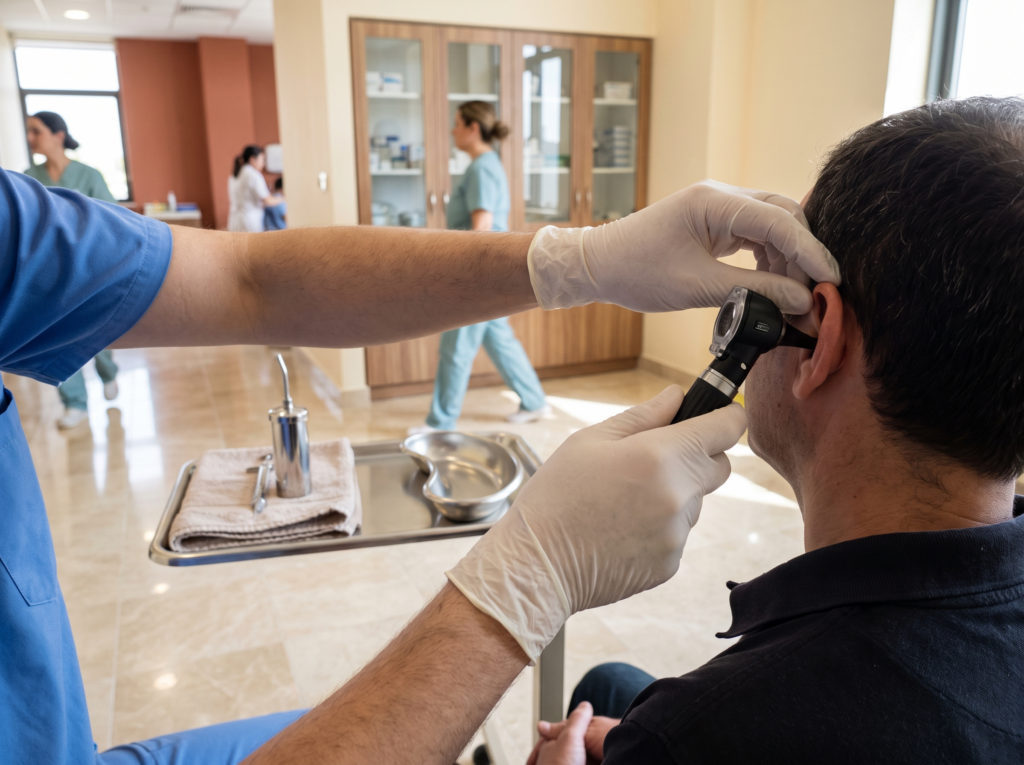
Swimmer’s ear is close to an occupational hazard here. Warm sea water, days in and out of the water, and a canal that never gets a chance to dry out properly. Ear infection treatment in Koh Phi Phi is quick and effective once someone has actually looked in the ear — and the reason to look is that outer and middle ear infections need entirely different treatment.
Outer ear or middle ear
Outer ear infection — otitis externa, swimmer’s ear — is an infection of the canal itself. The giveaway is that touching the ear hurts: pulling the earlobe or pressing the small flap in front of the canal produces a sharp wince. There is often itching first, then discharge, then a feeling of fullness.
Middle ear infection sits behind the eardrum. Pulling the ear does not hurt; the pain is deep and throbbing, usually after a cold, often with fever, and it can wake people at night. In children it is the commonest cause of a miserable night on holiday.
They are treated differently — drops for one, oral antibiotics and time for the other — and drops poured into the wrong ear achieve nothing. An otoscope settles it in seconds, which is why this is worth a visit rather than a pharmacy guess.
Why this island produces so many of them
Water sitting in the canal is the whole mechanism. It softens the skin, washes away the protective wax, and raises the pH so that bacteria that normally cannot get a foothold can.
Then the local pattern: several sessions in the water a day, long dive days, humidity that stops anything drying, and earplugs or hoods that trap moisture rather than keep it out.
And cotton buds, which are the accelerant. They scratch the canal skin and remove the wax that was protecting it, which is why the classic story here is a mildly itchy ear that became a genuinely painful one within a day of somebody trying to clean it.
What treatment involves
For outer ear infection: antibiotic drops, usually with a steroid to settle the swelling, for about a week. Where the canal is too swollen for drops to reach, a wick is placed to carry the medication in — an odd sensation and a large improvement.
Cleaning the canal first makes the drops work. Discharge and debris block them from reaching the infected skin, and that is often why over-the-counter drops bought at a pharmacy did nothing.
For middle ear infection: pain relief always, oral antibiotics where the picture warrants it. Many settle without antibiotics, particularly in adults, and the decision rests on fever, duration and how the eardrum actually looks — see the walk-in clinic.
Staying out of the water, and how long
This is the part nobody wants to hear. An outer ear infection needs the canal dry to heal, and that means no swimming, snorkelling or diving for the duration of treatment — usually seven to ten days.
Continuing to swim through it is the reliable way to turn a week’s problem into a fortnight’s. We see people who have carried on and are on their third round of drops, having lost more water time than if they had stopped at the start.
Showering is fine with a cotton ball smeared in petroleum jelly at the canal entrance. A proper fitted earplug is not enough on its own once the canal is infected — the seal traps moisture in rather than keeping it out.
The things that mean more than an ear infection
Come in promptly for any of these:
- Pain and swelling of the bone behind the ear
- Facial weakness or drooping on the side of the sore ear
- A high fever with severe ear pain
- Sudden hearing loss
- Severe dizziness or vertigo with the ear pain
- Ear infection in somebody diabetic or immunosuppressed
- Discharge that is bloody rather than yellow
The last group matters more than it looks. Outer ear infection in a diabetic traveller can spread to the bone, and that is a hospital problem rather than a drops problem. Both branches are open at any hour, and an ear that has gone from sore to severe overnight is a normal reason to come in at four in the morning.
Prevention, which genuinely works here
Dry your ears after every session. Tilt the head each way and let water run out, then dry the outside. Do not put anything inside.
Drying drops after swimming — either a proprietary product or equal parts white vinegar and rubbing alcohol — restore the canal’s acidity and evaporate residual water. Effective, cheap, and not to be used if there is any chance of a perforated eardrum or if the ear is already sore.
And leave the wax alone. Wax is the canal’s defence, not dirt. Where it has genuinely blocked the ear, have it removed properly rather than dug at — see ear wax removal.
Ears, diving and the pressure problem
An infected or swollen canal makes equalising harder, and a middle ear infection makes it close to impossible. Diving through either risks a perforated eardrum, which is a serious injury and turns a week of drops into months of caution.
Descending against a blocked Eustachian tube is how ear barotrauma happens, and the fact that it hurt on the way down is exactly the signal to abort rather than push.
If you have a course booked and an ear infection, come in early. Losing two days is better than losing the certification and the eardrum. We can put the reason in writing for the school — see dive medical and medical certificates.
Children, and the night-time version
Middle ear infections in children are the classic three-in-the-morning problem, and on an island with nothing else open that is genuinely difficult for parents.
Pain relief first and properly dosed by weight — paracetamol or ibuprofen makes the difference between a night and a nightmare. Many childhood ear infections settle within forty-eight hours without antibiotics, but the ones that do not need reviewing rather than waiting.
If getting a distressed child across the island at night is not realistic, we come to you. A doctor hotel visit for a screaming toddler with earache is one of the more common calls we take, and there is nothing unreasonable about making it.
Frequently asked questions
How do I know if it is swimmer’s ear?
Pulling the earlobe or pressing the flap in front of the ear hurts sharply. A middle ear infection does not do that.
Can I keep swimming while treating it?
No. An outer ear infection needs the canal dry, which means seven to ten days out of the water. Swimming through it doubles the duration.
Why did pharmacy drops not work?
Usually because the canal was blocked with discharge and the drops never reached the infected skin, or because it was a middle ear infection.
Do I need antibiotics?
Outer ear infections need drops rather than tablets. Middle ear infections often settle without antibiotics, and how the eardrum looks decides it.
How can I prevent it?
Dry the ears after every session, use drying drops, and leave the wax alone. Cotton buds are the main cause of the severe ones.
Can I dive with an ear infection?
No. Equalising is impaired and diving through it risks a perforated eardrum.
My child has earache at night. Should I wait until morning?
Pain relief first, and come in if it is not settling. Both branches are staffed overnight, and we will come to you if the walk is not realistic.
When is an ear infection serious?
Pain and swelling of the bone behind the ear, facial drooping, sudden hearing loss, severe vertigo, or any ear infection in a diabetic traveller.
The island arithmetic, and where we fit in it
English-speaking doctors on site, 24 hours a day. It is worth spelling out why that matters rather than leaving it as a claim. Koh Phi Phi has no hospital, no road connection and no ambulance service. Getting to an emergency department means a boat, and the scheduled boats run in daylight — so for a good part of every twenty-four hours, the island’s own clinic is not the convenient option, it is the only one. Everything about how we are staffed follows from that single fact.
Beyond the island, Doctor Phi Phi Takecare Clinic belongs to the Takecare Clinic group, which operates across Krabi and Phuket. The practical value of that is continuity: if your treatment carries on after you leave, the next clinic already holds your notes, and a referral is a phone call between colleagues rather than a stack of paperwork you have to carry yourself.
Coming in
Doctor Phi Phi Takecare Clinic is 24 hours, every day, and that is the building being open with a doctor in it rather than a phone line that answers. No appointment is needed at any point, and there is no hour at which turning up is inconvenient for us. There are 2 branches on the island, about ten minutes apart on foot, and both keep the same hours — so head for whichever is closer rather than looking for the right one. Walk in, or reach us on +66 82 140 3858 or WhatsApp. If you would rather not move, ask for a doctor hotel visit and we will come to you.
If it turns out this is beyond what the island can treat, the same conversation is where the boat and the hospital transfer start being arranged. That process is worth beginning early rather than late here, because the options genuinely narrow as the evening goes on — and a decision made at nine is a considerably better decision than the same one made at two in the morning.