HIV tests, same day, on Koh Phi Phi
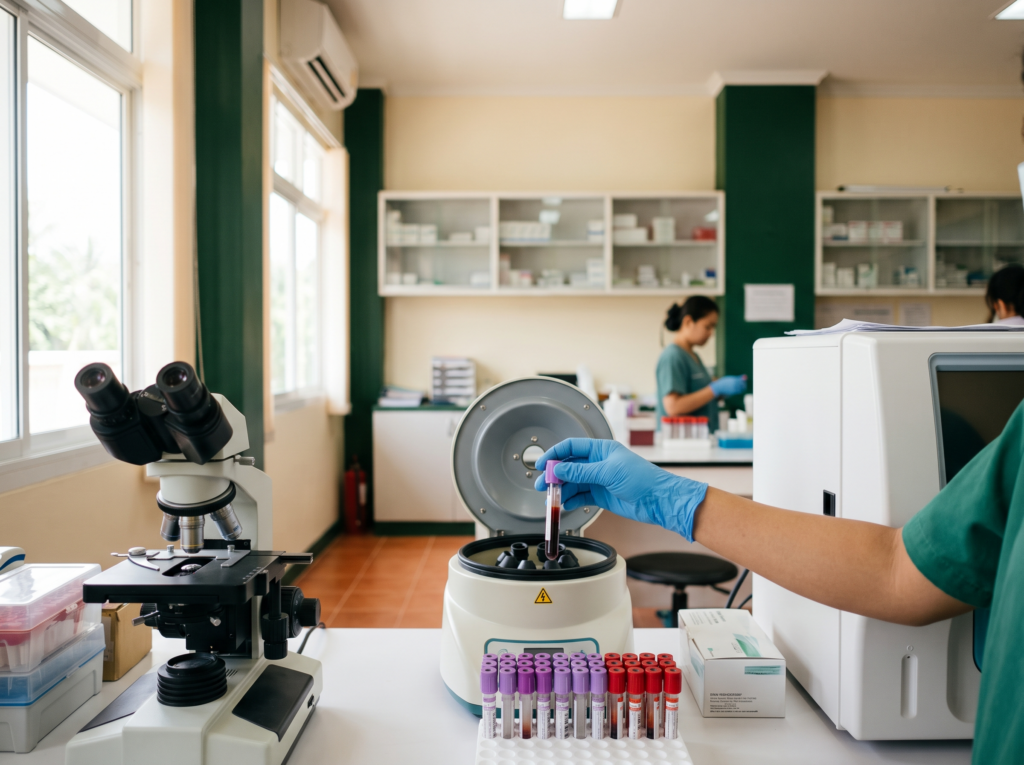
A rapid HIV test takes a finger-prick of blood and about twenty minutes, and you get the result in the room rather than by phone three days later. HIV testing in Koh Phi Phi is confidential, walk-in at any hour, and — for the great majority of people who come in worried — ends with a negative result and a considerably better night’s sleep.
How the test works
A small drop of blood from a finger prick, applied to a test cassette, read at twenty minutes. That is the whole procedure.
We use a fourth-generation test, which looks for both HIV antibodies and the p24 antigen. The antigen appears earlier in infection than antibodies do, which shortens the window period from twelve weeks to about four — a meaningful difference when you are waiting.
You wait in the clinic while it runs. There is no advantage to going away and coming back, and most people would rather not carry the question around the village for an afternoon.
The window period, and why it decides everything
A test cannot detect an infection that has not yet produced anything to detect. The interval between exposure and detectability is the window period, and misunderstanding it causes more distress than the tests themselves.
With a fourth-generation test, most infections are picked up from about four weeks after exposure. It is considered conclusive at six to twelve weeks. Before four weeks, a negative result tells you about your status before the exposure you are worried about, not after it.
That does not make early testing useless — a baseline is genuinely worth having, particularly if you will be tested again. It means we will tell you plainly what today’s result covers and give you a date to come back for one that settles it, rather than letting you leave with false reassurance.
If the exposure was in the last 72 hours
Then testing is not the priority and time is. PEP — post-exposure prophylaxis — is a month-long course of antiviral medication that can stop HIV establishing itself, and it has a hard cut-off at 72 hours.
Effectiveness falls with every hour of delay, so ideally it starts within a few hours rather than on day three. If you are reading this and the exposure was recent, come in now rather than after you have finished thinking about it — see PEP and PrEP.
Being on an island makes this more urgent rather than less, and it is the clearest single reason both branches run through the night. Waiting for morning on a seventy-two hour clock spends a meaningful fraction of the window on nothing at all.
What a reactive result actually means
A rapid test that comes back reactive is not a diagnosis. It is a screening result requiring a confirmatory laboratory test before it means anything, and false positives do occur.
If that happens, we arrange the confirmatory test immediately rather than leaving you with an unconfirmed result over a weekend, and we explain what the next steps look like in either direction. Nobody is sent out of the door with a piece of paper and a recommendation to see somebody at home.
And the fact worth stating clearly: HIV is now a manageable long-term condition with ordinary life expectancy on treatment, and treatment is available and affordable in Thailand. The diagnosis people are frightened of is not the diagnosis that exists.
Confidentiality on a small island
Results go to you and to nobody else. Not your hotel, not your travel insurer without your consent, not the people you came with, and not Thai immigration.
You are seen like any other patient and no reason for the visit is stated anywhere anybody else can see. If you would rather the receipt did not itemise an HIV test, say so and it will read as a consultation and blood test, which is accurate.
HIV testing has no bearing on your Thai visa and is not reported to any authority. On an island this small, discretion is not a policy we advertise — it is the only way a clinic like this could function at all, and everybody working here understands that.
Who should test, beyond the obvious
Anybody after unprotected sex with a new partner, anybody whose condom broke, and anybody who has shared needles for any purpose, including steroid use and cosmetic injections.
Also: anybody who has had a tattoo or piercing somewhere the sterilisation looked uncertain — which on this island is worth thinking about honestly — anybody who has had a medical or dental procedure in a setting they were not confident about, and anybody with a new diagnosis of another sexually transmitted infection, because the risk factors overlap heavily. See STD testing for the wider panel.
And anybody who simply wants to know. That is a sufficient reason on its own, and a large proportion of the tests we run are for exactly that.
Season workers, and the test that gets postponed
The group that most often puts this off is the one that lives here.
Dive instructors, bar staff and hotel workers who have been on the island for months tend to carry the question rather than answer it, partly because they will see the same faces in the clinic waiting area that they see at work. That is understandable and it is also why the discretion above is not a slogan.
It is a twenty-minute job on a quiet morning. Doing it on an ordinary Tuesday rather than after a scare is easier in every respect, and the overwhelming likelihood is that you walk out having stopped thinking about it.
PrEP, if this is going to keep happening
If you find yourself worrying about this repeatedly, testing after the fact is treating the anxiety rather than the risk. PrEP is medication taken before exposure that is extremely effective at preventing HIV.
It is straightforward to start, widely used in Thailand, and involves a baseline test plus kidney function checks. For somebody spending a season on the island it is a considerably better arrangement than a rapid test every few weeks.
PrEP prevents HIV and nothing else, so testing for other infections continues alongside it. See PEP and PrEP for how both work, and blood tests for the monitoring that goes with it.
Frequently asked questions
How long does the result take?
About twenty minutes, and you wait in the clinic for it.
How soon after exposure is a test reliable?
A fourth-generation test detects most infections from about four weeks, and is considered conclusive at six to twelve.
Is it confidential?
Yes. The result goes to you alone — not to your hotel, your travel companions or Thai immigration.
Can I be tested at 2am?
Yes. Both branches are staffed around the clock, and for anything on a 72-hour clock that matters a great deal.
Does it affect my visa?
No. HIV testing here is not reported to immigration and has no bearing on your visa.
What if the test is reactive?
It is a screening result, not a diagnosis, and needs laboratory confirmation. We arrange that immediately rather than leaving you waiting.
I work here and would rather not be seen. Is that manageable?
Yes. You are seen like any other patient, no reason for the visit is stated anywhere, and there are two branches if one feels easier than the other.
How much does it cost?
A rapid HIV test is inexpensive and quoted before it is done.
The island arithmetic, and where we fit in it
English-speaking doctors on site, 24 hours a day. It is worth spelling out why that matters rather than leaving it as a claim. Koh Phi Phi has no hospital, no road connection and no ambulance service. Getting to an emergency department means a boat, and the scheduled boats run in daylight — so for a good part of every twenty-four hours, the island’s own clinic is not the convenient option, it is the only one. Everything about how we are staffed follows from that single fact.
Beyond the island, Doctor Phi Phi Takecare Clinic belongs to the Takecare Clinic group, which operates across Krabi and Phuket. The practical value of that is continuity: if your treatment carries on after you leave, the next clinic already holds your notes, and a referral is a phone call between colleagues rather than a stack of paperwork you have to carry yourself.
Coming in
Doctor Phi Phi Takecare Clinic is 24 hours, every day, and that is the building being open with a doctor in it rather than a phone line that answers. No appointment is needed at any point, and there is no hour at which turning up is inconvenient for us. There are 2 branches on the island, about ten minutes apart on foot, and both keep the same hours — so head for whichever is closer rather than looking for the right one. Walk in, or reach us on +66 82 140 3858 or WhatsApp. If you would rather not move, ask for a doctor hotel visit and we will come to you.
If it turns out this is beyond what the island can treat, the same conversation is where the boat and the hospital transfer start being arranged. That process is worth beginning early rather than late here, because the options genuinely narrow as the evening goes on — and a decision made at nine is a considerably better decision than the same one made at two in the morning.