Treating a sore throat on Koh Phi Phi
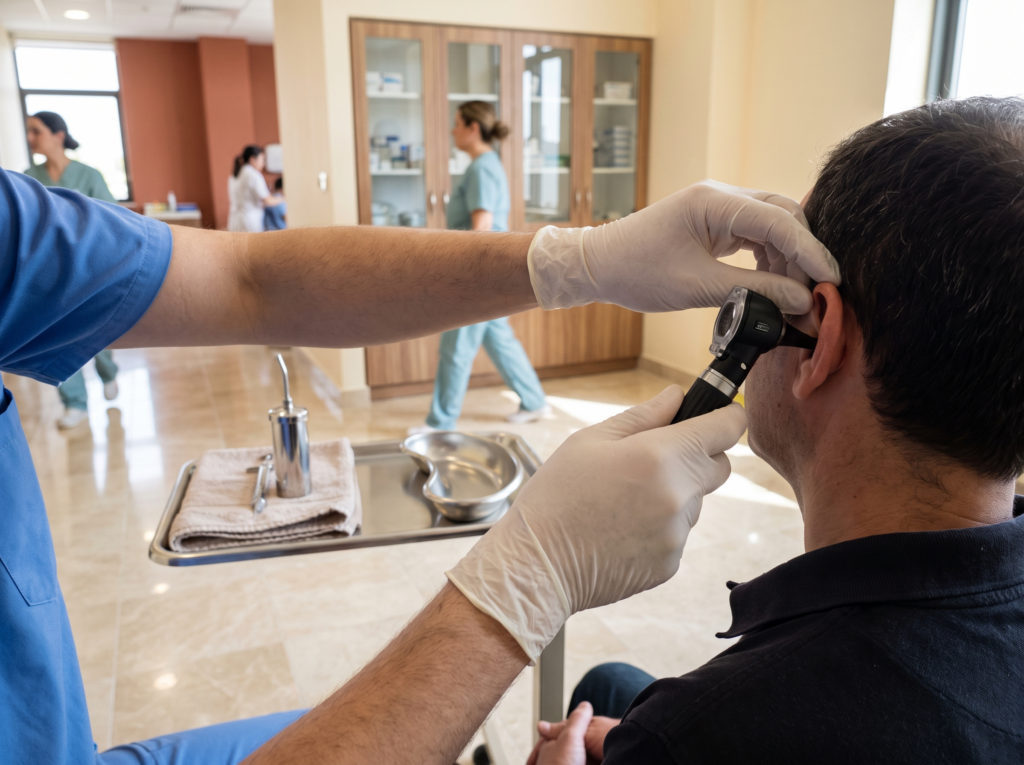
A sore throat on holiday is usually nothing, and occasionally it is the one that needs an antibiotic. The difference is not how much it hurts. Sore throat treatment in Koh Phi Phi takes a few minutes — a look, sometimes a swab, and a straight answer about whether this is a virus to ride out or a bacterial infection worth treating.
Virus or bacteria, and how we tell
Around eight in ten sore throats are viral, and antibiotics do nothing for them. The clues are the company it keeps: a runny nose, a cough, hoarseness, sneezing. Viruses tend to involve the whole upper airway rather than the throat alone.
Bacterial tonsillitis, usually streptococcal, looks different. Sudden onset, high fever, white patches on the tonsils, tender swollen glands in the neck, and characteristically no cough at all. Swallowing is genuinely difficult rather than uncomfortable.
A rapid strep swab gives an answer in minutes where the picture is unclear, which is better than either handing out an antibiotic that will not help or withholding one that would.
Why throats get sore on this island specifically
Air conditioning is the leading cause and the one people never suspect. Sleeping under a cold unit blowing dry recirculated air dries the throat lining overnight, and you wake up raw. It resolves within hours of the room being warmer and better ventilated.
Then the obvious ones: shouting over music, smoking more than usual, drinking more than usual, and long dry hours in air-conditioned boats and buses. Sea water and chlorine irritate too.
And the crowding. Shared dorms, packed ferries, day boats where forty people spend six hours together. Anything airborne moves efficiently through that, which is why sore throats here often arrive in clusters among people who did the same trip.
When it needs treating rather than waiting
Come in for any of these:
- Difficulty swallowing your own saliva, or drooling
- Difficulty breathing, or a change in your voice to a muffled quality
- Inability to open the mouth fully
- Swelling on one side of the throat, pushing the tonsil across
- A fever above 38.5 with white patches on the tonsils
- A sore throat lasting beyond a week
- A rash alongside the sore throat
The one-sided swelling with muffled speech is a quinsy — an abscess beside the tonsil. It needs draining rather than tablets, and it is the sore throat that turns into a boat trip if it is left. That is a reason to come in at two in the morning rather than wait for daylight.
What actually helps a viral sore throat
Regular paracetamol or, where dengue is not a question, ibuprofen — anti-inflammatories work well on throat pain specifically. Take them by the clock for the first two days rather than when it gets bad again.
Salt water gargles several times a day, warm rather than hot. Lozenges with a local anaesthetic before meals, so you can eat. Cold drinks and ice lollies, which are more effective than they sound and are one of the few upsides of being ill in the tropics.
Honey in warm water genuinely helps, particularly at night. And humidity — turn the air conditioning up a few degrees, or off overnight with a fan instead. That single change fixes a surprising number of throats here without any medication.
Antibiotics, and why we do not simply hand them over
Where strep is confirmed or strongly suspected, antibiotics shorten the illness, reduce transmission and prevent the rare but serious complications. That is a clear case for treating.
Where it is viral, an antibiotic gives you the side effects with none of the benefit, disturbs your gut for weeks, and contributes to resistance that matters to everyone. Pharmacies in Thailand will often sell them over the counter, which is precisely why it is worth having someone look at the throat first.
If you are given a course, finish it. Stopping on day three because you feel better is the pattern that leaves the infection half-treated and brings people back in a week.
When a sore throat is a symptom of something else
Glandular fever behaves differently — a sore throat that drags on for weeks, profound fatigue, large neck glands, often in a younger traveller. It is worth identifying, partly because certain antibiotics cause a dramatic rash in it, and partly because it changes what you should be doing for the next month.
A sore throat with a fever and no cold symptoms in this region is also worth a broader look, particularly with body aches — see fever treatment. And a persistent throat problem alongside facial pain and thick discharge is often a sinus infection draining down the back of the throat.
Rarely, a sore throat is the first sign of a recent HIV infection, presenting as a flu-like illness a few weeks after exposure. That is not a common answer, but if the timing and history fit, testing is straightforward and confidential — see HIV testing and STD testing.
Diving with a sore throat
The throat itself is not the problem. The congestion that comes with it is, because a blocked Eustachian tube stops you equalising, and forcing it is how eardrums get damaged and how barotrauma happens.
If you can clear your ears easily on land and there is no fever, a mild sore throat need not cancel a dive. If your nose is blocked, it should, whatever the schedule says and whatever a decongestant seems to promise — decongestants wear off at depth, which is when the problem becomes real.
Where a course has to be rearranged, we can put the reason in writing for the school or the insurer. Come in the day before rather than at the pier — see dive medical and the walk-in clinic.
Getting seen without walking across the island
Most sore throats are a short walk from Ao Tonsai or Ao Lo Dalum, and we would rather look at it than guess over a phone.
For anybody genuinely struggling to swallow, or staying on one of the eastern bays with no easy path back at night, a doctor hotel visit makes more sense than a boat in the dark.
Either way, do not spend four days of a two-week trip being miserable on the assumption that nothing can be done. Half of what fixes a throat here is a swab and a straight answer, and the other half is turning the air conditioning down.
Frequently asked questions
Do I need antibiotics for a sore throat?
Usually not — around eight in ten are viral. A swab tells us in minutes when the picture is unclear.
How do I know if it is strep?
Sudden onset, high fever, white patches on the tonsils, tender neck glands and characteristically no cough.
Why does my throat hurt every morning here?
Almost always the air conditioning drying the throat overnight. Turn it up a few degrees or use a fan instead.
What helps most for the pain?
Regular paracetamol or ibuprofen taken by the clock, salt water gargles, anaesthetic lozenges before meals, and cold drinks.
When is a sore throat an emergency?
Trouble swallowing your own saliva, drooling, muffled voice, one-sided swelling, or difficulty opening your mouth. Come in at any hour.
Can I dive with a sore throat?
If your ears clear easily and there is no fever, often yes. If your nose is blocked, no — decongestants wear off at depth.
Can I just buy antibiotics from a pharmacy here?
Often you can, which is exactly why having someone look at the throat first is worth the few minutes.
My sore throat has lasted two weeks. Is that normal?
No. That warrants a look — glandular fever and other causes behave that way and need identifying.
The island arithmetic, and where we fit in it
English-speaking doctors on site, 24 hours a day. It is worth spelling out why that matters rather than leaving it as a claim. Koh Phi Phi has no hospital, no road connection and no ambulance service. Getting to an emergency department means a boat, and the scheduled boats run in daylight — so for a good part of every twenty-four hours, the island’s own clinic is not the convenient option, it is the only one. Everything about how we are staffed follows from that single fact.
Beyond the island, Doctor Phi Phi Takecare Clinic belongs to the Takecare Clinic group, which operates across Krabi and Phuket. The practical value of that is continuity: if your treatment carries on after you leave, the next clinic already holds your notes, and a referral is a phone call between colleagues rather than a stack of paperwork you have to carry yourself.
Coming in
Doctor Phi Phi Takecare Clinic is 24 hours, every day, and that is the building being open with a doctor in it rather than a phone line that answers. No appointment is needed at any point, and there is no hour at which turning up is inconvenient for us. There are 2 branches on the island, about ten minutes apart on foot, and both keep the same hours — so head for whichever is closer rather than looking for the right one. Walk in, or reach us on +66 82 140 3858 or WhatsApp. If you would rather not move, ask for a doctor hotel visit and we will come to you.
If it turns out this is beyond what the island can treat, the same conversation is where the boat and the hospital transfer start being arranged. That process is worth beginning early rather than late here, because the options genuinely narrow as the evening goes on — and a decision made at nine is a considerably better decision than the same one made at two in the morning.