Treating traveller’s diarrhoea on Koh Phi Phi
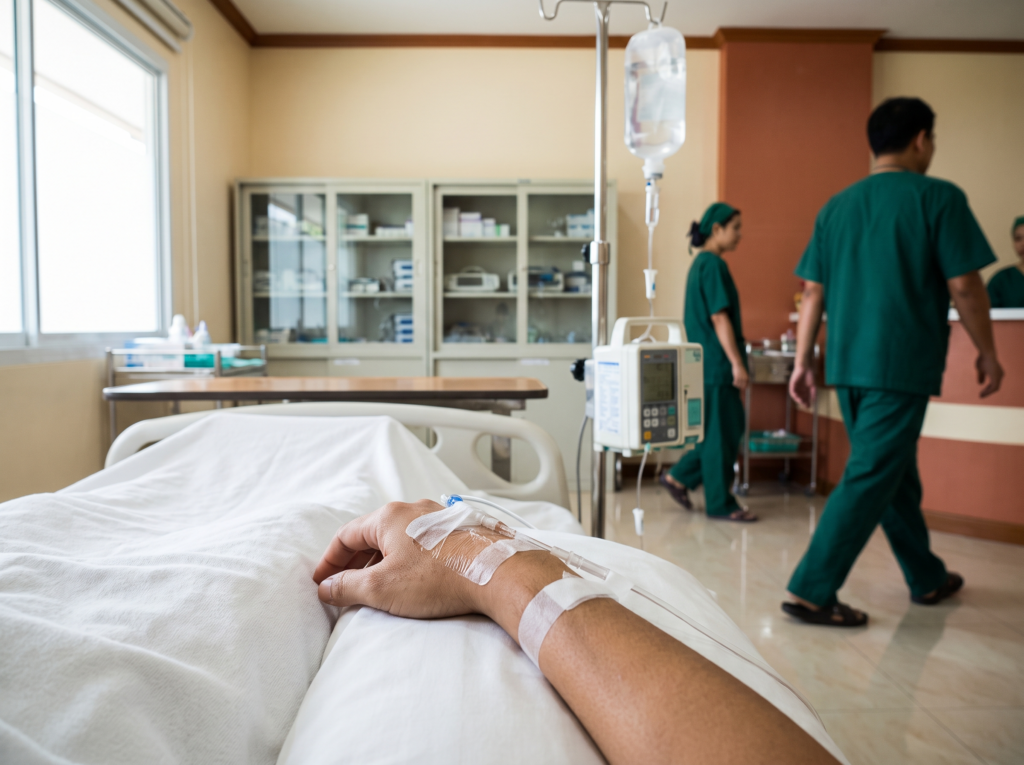
It is the single commonest reason travellers see a doctor in Southeast Asia, and on Phi Phi it tends to arrive on day two or three, once your gut has met enough that is unfamiliar to it. Traveller’s diarrhoea treatment in Koh Phi Phi is mostly about replacing what you are losing, deciding whether anything more is needed, and getting you back on a boat rather than stuck near a bathroom.
What it actually is
Three or more loose stools in a day, with cramping, urgency, sometimes nausea and a mild fever. It usually starts in the first week of a trip and it is caused far more often by bacteria than by anything exotic.
The mechanism is unglamorous. Your gut has a settled population of organisms it recognises; travel introduces new ones, in the water, on unwashed produce, in ice, on hands. Most people adapt within days. Some do not, and get a few unpleasant ones instead.
Overlapping with this is food poisoning, which comes on faster and harder from a single identifiable meal. The first day of treatment looks much the same either way, which is why the label matters less than the fluid balance.
The fluid problem, which is the real one
Nobody is harmed by the diarrhoea itself in a healthy adult. They are harmed by the water and salt going out faster than it is going in, in thirty-plus degree heat, while already sweating.
Oral rehydration salts are the treatment, not a supplement to it. Sachets dissolved in clean water, sipped steadily through the day. The glucose and salt combination is what lets your gut absorb water it would otherwise pass straight through, which is why plain water does less than people assume.
Watch your urine rather than how you feel — dark, scant or absent means you are behind. Dizziness on standing, a dry mouth and a fast pulse mean you are well behind, and that is worth coming in for rather than pushing through.
When to come in
Most cases settle in two to four days. Come in sooner if any of these apply:
- Blood or mucus in the stool
- Fever above 38.5 degrees
- Severe abdominal pain rather than crampy discomfort
- Vomiting that stops you keeping fluids down
- Symptoms past three or four days with no sign of easing
- Any of it in a child, an older traveller, or somebody pregnant
- A boat or flight booked that you cannot realistically make
That last one is not a soft reason. A four-hour ferry and transfer while badly dehydrated is genuinely miserable, and often the practical fix is an IV drip the morning of travel rather than gambling on it.
Testing, and when it is worth doing
Most straightforward cases need no test at all. Where the picture is not straightforward — fever, blood, or symptoms that have run past a few days — a stool test tells us whether we are dealing with a bacterial infection, a parasite, or something that will pass on its own.
Parasitic causes such as giardia behave differently. They tend to come on more gradually, last longer, and produce a bloating and sulphurous belching that people describe unprompted and unmistakably. They need specific treatment, and no amount of waiting will clear them.
Bloods sometimes go alongside, particularly where dehydration looks significant or the fever pattern raises other possibilities — see blood tests. On an island in dengue country, a fever with diarrhoea is not automatically a gut problem, and dengue is worth excluding rather than assuming.
Antibiotics and stopping medication, used properly
Antibiotics shorten the bacterial kind considerably — often from four days to one. They do nothing for the viral kind and they disturb your gut flora, which can leave you worse off a fortnight later. So they are worth using where the picture fits and worth avoiding where it does not.
Loperamide is the anti-motility drug most people carry. It genuinely helps for a long boat journey or a flight where you simply need to hold on. It is the wrong choice with fever or blood in the stool, because slowing the gut keeps an invasive infection where it can do more harm.
The combination people should not self-prescribe is loperamide plus whatever antibiotic a friend had left over. If it has gone beyond fluids and rest, ten minutes at the walk-in clinic gets it right the first time.
The island specifics
Ice is the recurring culprit. Most bars here use commercially produced tube ice, which is fine; the risk sits with crushed ice made on site and with the cooler it was stored in. If the ice has an unusual shape and a bar looks improvised, that is a reasonable thing to skip.
Then salads and fruit rinsed in tap water, seafood held too long between boat and plate, and buffet dishes sitting warm through a long evening. Water itself is not the problem in bottles, but the tap is not drinking water here and using it to brush your teeth is a small unnecessary exposure.
Hand hygiene does more than food avoidance. Between shared boats, shared bathrooms and a lot of shared plates, hands are the main route, and a small bottle of sanitiser in your day bag genuinely reduces the odds.
Eating through it
Do not starve yourself. Old advice said to fast; current advice says eat what you can tolerate, because your gut lining recovers faster with something to work with.
Start plain and bland — rice, plain noodles, toast, bananas, clear broth. Add back protein as your appetite returns. Dairy is often poorly tolerated for a week or two, and lactose intolerance after a gut infection is common and temporary.
Skip alcohol until you are properly right, which on this island takes a certain resolve. It irritates the gut lining, worsens dehydration, and reliably sets people back a day just when they were improving.
Diving, boats and getting on with the trip
Do not dive while symptomatic. Vomiting or urgency underwater is dangerous, dehydration is a known contributor to decompression illness, and a full day on a dive boat with a cramping gut is a poor idea for reasons beyond your own comfort.
Once you have been settled for twenty-four hours and are rehydrated, most people are fine to go back. If you have a course booked and lost days to this, we can put the timeline in writing — see dive medical and medical certificates.
If you are stuck in a bungalow on one of the eastern bays and the walk is not realistic, we come to you. A doctor hotel visit at three in the morning is a normal request on an island where nothing is open and the pier is a long way in the dark.
Frequently asked questions
How long does traveller’s diarrhoea last?
Usually two to four days. Past that, or with fever or blood, it needs assessing rather than waiting out.
What is the best thing to drink?
Oral rehydration salts in clean water, sipped steadily. Plain water alone does less, because you are losing salt as well.
Should I take loperamide?
Useful for a long boat or flight. Wrong if there is fever or blood in the stool, because it keeps an invasive infection in place.
Do I need antibiotics?
Only where the picture is bacterial. They shorten that considerably and do nothing for the viral kind.
Is the ice safe here?
Commercial tube ice generally is. Crushed ice made on site, and the cooler it sat in, is the more common source.
Should I stop eating?
No. Eat plain food as you tolerate it — rice, toast, bananas, broth. Your gut lining recovers faster with something to work with.
When can I dive again?
Once you have been settled for about twenty-four hours and rehydrated. Not while symptomatic.
Can a doctor come to my hotel?
Yes, at any hour. On the eastern bays that is often more practical than getting yourself to the pier.
The island arithmetic, and where we fit in it
English-speaking doctors on site, 24 hours a day. It is worth spelling out why that matters rather than leaving it as a claim. Koh Phi Phi has no hospital, no road connection and no ambulance service. Getting to an emergency department means a boat, and the scheduled boats run in daylight — so for a good part of every twenty-four hours, the island’s own clinic is not the convenient option, it is the only one. Everything about how we are staffed follows from that single fact.
Beyond the island, Doctor Phi Phi Takecare Clinic belongs to the Takecare Clinic group, which operates across Krabi and Phuket. The practical value of that is continuity: if your treatment carries on after you leave, the next clinic already holds your notes, and a referral is a phone call between colleagues rather than a stack of paperwork you have to carry yourself.
Coming in
Doctor Phi Phi Takecare Clinic is 24 hours, every day, and that is the building being open with a doctor in it rather than a phone line that answers. No appointment is needed at any point, and there is no hour at which turning up is inconvenient for us. There are 2 branches on the island, about ten minutes apart on foot, and both keep the same hours — so head for whichever is closer rather than looking for the right one. Walk in, or reach us on +66 82 140 3858 or WhatsApp. If you would rather not move, ask for a doctor hotel visit and we will come to you.
If it turns out this is beyond what the island can treat, the same conversation is where the boat and the hospital transfer start being arranged. That process is worth beginning early rather than late here, because the options genuinely narrow as the evening goes on — and a decision made at nine is a considerably better decision than the same one made at two in the morning.