Treating sunburn on Koh Phi Phi
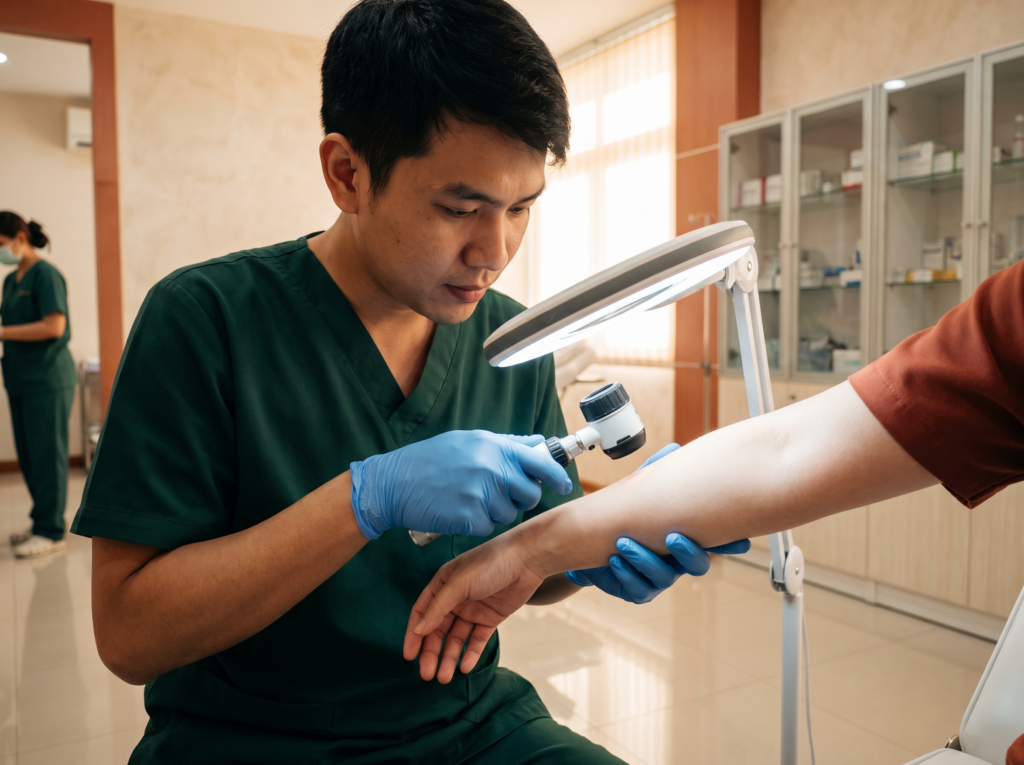
The sun here is stronger than it feels. Sea breeze on a boat, cloud that does not block ultraviolet, and reflection off water and white sand mean people burn on days they would have called overcast at home. Sunburn treatment in Koh Phi Phi ranges from cooling and fluids to genuine medical treatment for blistered burns — and the severe ones almost always happened on a boat.
Why people burn so badly here
Latitude. Phi Phi sits about seven and a half degrees north of the equator, where the ultraviolet index routinely reaches 11 or higher between ten and four. That is roughly three times the burning power of a European summer afternoon, and the burn time for untanned skin can be under fifteen minutes.
Water and white sand reflect a substantial share of that back at you, so the shade of a beach umbrella is far less protective than it looks. Water offers almost none — snorkelling face down for an hour is one of the reliable ways to end up with a burned back here.
And the breeze removes the sensation that would normally warn you. On a moving boat the skin feels cool while the damage accumulates, which is why the day-trip to Maya Bay and Bamboo Island produces most of the severe burns we treat.
How bad is it, in practical terms
Mild: red, warm, sore, no blisters. Peels in a few days and needs cooling, moisturising and fluids.
Moderate: deep red, painful, swollen, small blisters. Feeling unwell alongside it — nausea, headache, chills — is common and is the body responding to a genuine injury rather than a separate illness.
Severe: extensive blistering, severe pain, fever, dizziness, confusion. That is a burn requiring proper treatment, and on an island it is worth being seen rather than managed with aloe from a shop — see burn treatment.
What to do in the first hours
Get out of the sun completely, and stay out for the rest of the day at minimum. Cool the skin with a cool shower or damp cloths, not ice, which damages already injured skin.
Drink considerably more than feels necessary. A burn pulls fluid into the skin and away from circulation, and combined with a day of sweating it is why sunburned people feel dizzy and headachy by evening. Oral rehydration salts do more than water alone.
Aloe vera gel, ideally refrigerated, genuinely helps. Anti-inflammatories such as ibuprofen reduce both pain and the inflammation itself, and are worth taking early rather than waiting — with the standing caution that if there is any question of dengue, paracetamol is the only safe choice.
Blisters, and what not to do with them
Do not pop them. Blister roof is a sterile dressing your body made, and breaking it opens a wound in a climate full of bacteria that thrive in warm salt water.
Large or awkwardly placed blisters sometimes need draining properly, with the roof left in place and a dressing over the top. That is a clinic job rather than a hotel bathroom job, and it takes minutes.
Signs a burn has become infected: increasing pain after day two rather than decreasing, spreading redness beyond the burn edge, yellow discharge, red streaking, or fever. Infection on burned skin escalates quickly here — see wound dressing and cellulitis.
Sun poisoning, and when to come in
Severe sunburn produces a systemic reaction that people do not connect to their skin. Nausea, vomiting, headache, chills, shivering, dizziness and profound fatigue — feeling genuinely ill some hours after a day on a boat.
That usually overlaps with dehydration and heat exhaustion, and the combination is what puts people on an IV drip for a couple of hours before they feel human again.
Come in for extensive blistering, a burn covering a large area, fever, vomiting, confusion or fainting, severe pain unmanaged by simple painkillers, sunburn in a small child, or any burn that seems to be getting worse rather than better after two days. Both branches are staffed at any hour, and sunburn tends to peak around midnight after the day it happened.
Eyes, lips and the places people miss
Corneal sunburn — photokeratitis — is a real and painful thing here, from hours of glare off water without sunglasses. It announces itself six to twelve hours later, usually at night: intense pain, watering, light sensitivity and a feeling of grit in both eyes. It heals within a day or two but the night is miserable, and it is worth being seen — see eye treatment.
Lips burn badly and are rarely protected. So are ears, the tops of the feet on a sun lounger, the parting of the hair, and the backs of the knees.
And the classic snorkelling burn: the backs of the thighs, the lower back where a rash vest rides up, and the back of the neck. A long-sleeved rash vest prevents more sunburn on this island than any bottle of sunscreen.
Sunscreen, and using it in a way that works
Most people apply roughly a quarter of what the rating assumes. A full body application is about the volume of a shot glass, and factor 30 applied thinly performs like a much lower number.
Reapply every two hours and after every swim, whatever the bottle claims about being waterproof. Apply twenty minutes before going out rather than on the beach.
Reef-safe mineral formulations matter here. Oxybenzone and octinoxate damage coral, and some Thai marine parks restrict them. Zinc-based products protect skin better in this intensity anyway, and do not sting when they run into your eyes with sweat, which is the reason most people stop reapplying.
Diving, boats and the days afterwards
Wetsuits and BCD straps over burned skin are genuinely painful, and blistered skin under neoprene tends to break down. A day or two out of the water is usually the right answer, and rushing it risks an infected burn rather than a healed one — see dive medical.
Peeling skin should be left alone rather than pulled, moisturised regularly, and kept fully covered from the sun for at least a week. New skin under a peel burns far faster than the skin it replaced.
And if a burn has cost you dive days or a booked trip, get it documented while you are here rather than reconstructing it later — see travel insurance claims.
Frequently asked questions
Why do I burn so much faster here?
The UV index routinely reaches 11 or higher — roughly three times a European summer. Untanned skin can burn in under fifteen minutes.
Should I pop sunburn blisters?
No. The blister roof is a sterile cover your body made. Large ones can be drained properly at the clinic with the roof left in place.
Why do I feel sick after a day in the sun?
Severe sunburn causes a whole-body reaction — nausea, chills, headache — usually alongside dehydration. Fluids help, and an IV helps faster.
Can I still burn on a cloudy day?
Yes. Cloud does not block ultraviolet, and the sea breeze on a boat removes the warning sensation while the damage continues.
My eyes hurt after a day on the water. Is that sunburn?
Probably corneal sunburn from glare. It appears six to twelve hours later, usually at night, and is worth being seen for.
How much sunscreen should I actually use?
About a shot glass for a full body application, reapplied every two hours and after every swim. Most people use a quarter of that.
When should I come in for sunburn?
Extensive blistering, fever, vomiting, confusion, severe pain, sunburn in a small child, or a burn worsening after two days.
Can I dive with sunburn?
Not comfortably, and blistered skin under neoprene tends to break down. A day or two out of the water is usually right.
The island arithmetic, and where we fit in it
English-speaking doctors on site, 24 hours a day. It is worth spelling out why that matters rather than leaving it as a claim. Koh Phi Phi has no hospital, no road connection and no ambulance service. Getting to an emergency department means a boat, and the scheduled boats run in daylight — so for a good part of every twenty-four hours, the island’s own clinic is not the convenient option, it is the only one. Everything about how we are staffed follows from that single fact.
Beyond the island, Doctor Phi Phi Takecare Clinic belongs to the Takecare Clinic group, which operates across Krabi and Phuket. The practical value of that is continuity: if your treatment carries on after you leave, the next clinic already holds your notes, and a referral is a phone call between colleagues rather than a stack of paperwork you have to carry yourself.
Coming in
Doctor Phi Phi Takecare Clinic is 24 hours, every day, and that is the building being open with a doctor in it rather than a phone line that answers. No appointment is needed at any point, and there is no hour at which turning up is inconvenient for us. There are 2 branches on the island, about ten minutes apart on foot, and both keep the same hours — so head for whichever is closer rather than looking for the right one. Walk in, or reach us on +66 82 140 3858 or WhatsApp. If you would rather not move, ask for a doctor hotel visit and we will come to you.
If it turns out this is beyond what the island can treat, the same conversation is where the boat and the hospital transfer start being arranged. That process is worth beginning early rather than late here, because the options genuinely narrow as the evening goes on — and a decision made at nine is a considerably better decision than the same one made at two in the morning.