Treating a skin rash on Koh Phi Phi
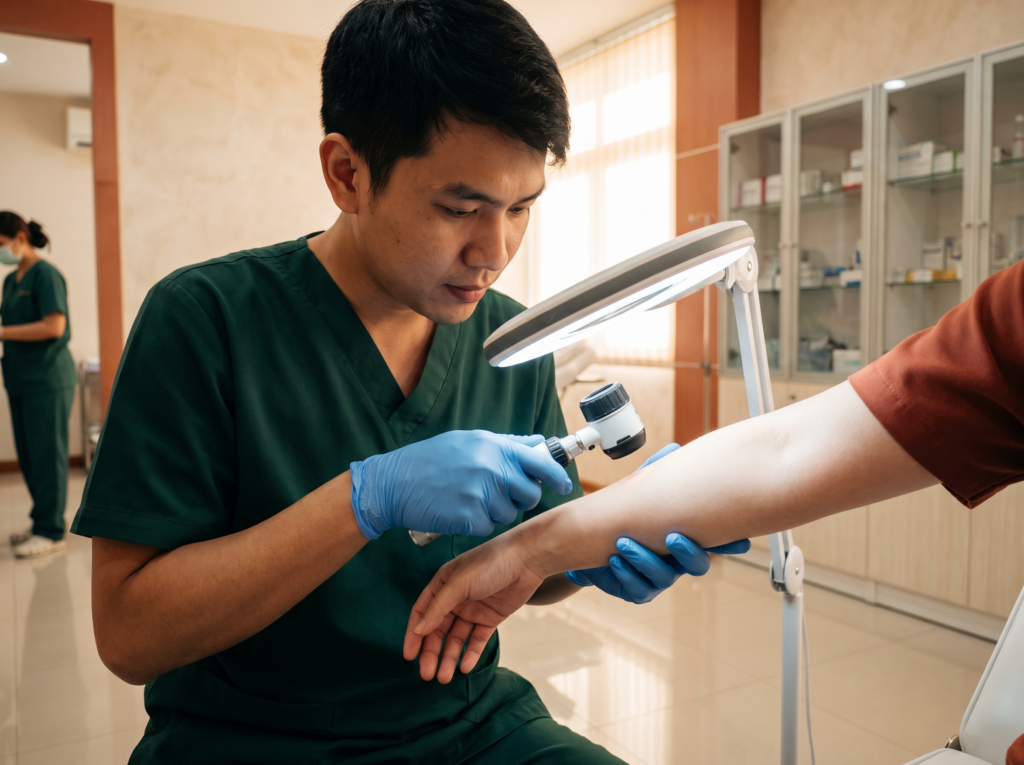
Skin behaves differently in the tropics. Heat, salt, sun, sweat and a fortnight of damp clothing produce rashes that most travellers have never had at home and cannot identify. Skin rash treatment in Koh Phi Phi is mostly a matter of naming it correctly — because fungal, bacterial, allergic and heat rashes look similar to the untrained eye and need opposite treatments.
The rashes we see most on this island
Heat rash — prickly heat — is the commonest by a distance. Tiny itchy bumps where sweat ducts have blocked, typically on the chest, back, waistband and under bra straps. It appears in the first week, when your skin has not yet adjusted to sweating this much.
Fungal infections are next. Ringworm as expanding rings with a clear centre, jock itch in the groin, athlete’s foot between the toes, and pityriasis versicolor as pale or darker patches across the shoulders and chest that become obvious as you tan.
Then contact reactions to sunscreen, insect repellent, new detergent or a hotel’s laundry. Sun-related rashes, particularly polymorphic light eruption on the first properly sunny days. And bacterial infection where any of the above has been scratched open.
Why the difference matters more than it sounds
A steroid cream calms an allergic or heat rash quickly. Put the same cream on a fungal infection and it suppresses the local immune response, which makes the fungus spread faster and blurs its edges so it becomes harder to recognise.
That is the single most common mistake we correct here. Somebody buys a strong combination cream from a pharmacy, the itch improves for two days, and a fortnight later there is a large, faint, oddly shaped patch that no longer looks like anything.
Antifungals, conversely, do nothing for heat rash or contact dermatitis and can irritate them. So the few minutes it takes to look properly — sometimes with a skin scraping — decides whether the next week is treatment or aggravation.
Heat rash, and how to actually clear it
The treatment is cooling and drying, not creams. Time in air conditioning, cool showers without hot water, loose cotton rather than synthetic fabrics, and letting the skin dry fully before dressing.
Calamine helps the itch. So does a light antihistamine at night, mostly because it stops the scratching that turns a nuisance into an infection.
What makes it worse: heavy sunscreens and thick moisturisers that block the ducts further, tight sportswear, sitting in wet swimwear, and staying in the heat all day. It resolves in days once the skin is allowed to cool, and it comes straight back if it is not.
Fungal rashes in a climate built for them
Warm, damp and covered is what fungus wants, and a beach holiday supplies all three continuously. Wet swimwear worn for hours, shoes that never dry, skin folds that stay damp between showers.
Treatment is an antifungal cream for two to four weeks, and the important part is continuing for a week or two after the rash has gone. Stopping when it looks clear is why fungal rashes recur, and people conclude the cream did not work when in fact it was withdrawn early.
Alongside that: change out of wet swimwear rather than drying off in it, wear sandals in shared bathrooms, dry between the toes and in every fold, and use a separate towel for the affected area. Widespread or stubborn cases sometimes need oral treatment, which is a decision worth making with someone rather than at a pharmacy counter.
When a rash needs seeing quickly
Come in without waiting for any of these:
- A rash with fever
- A rash that does not fade when pressed with a glass
- Spreading redness that is hot to touch, with a defined advancing edge
- Blistering, or skin peeling away
- Any rash involving the eyes, mouth or genitals
- Swelling of the lips, tongue or face, or any difficulty breathing
- A rash after starting a new medication
Facial or airway swelling is an emergency and needs treating within minutes rather than hours — see emergency care. Spreading hot redness with a clear edge is likely cellulitis, which on this island is common because of how sea water and small cuts interact.
Sea water rashes, which are their own category
Seabather’s eruption — an itchy rash under swimwear, where tiny jellyfish larvae get trapped against the skin and sting when the costume is squeezed or rinsed in fresh water. Intensely itchy, harmless, and much reduced by rinsing in sea water first and getting out of the swimsuit promptly.
Then coral and sponge contact, which produces a burning rash hours later, and sea lice. And jellyfish stings, which leave linear welts rather than a diffuse rash and are treated differently.
Anything from the sea that involves broken skin needs watching rather than dismissing. Marine bacteria are not the same as the ones on land, and a graze that would be trivial at home behaves differently here — see coral cuts and wound dressing.
Sunscreen, repellent and the reactions they cause
Chemical sunscreens cause more contact reactions than people realise, and the pattern gives it away: the rash follows exactly where it was applied and stops at the edges. Switching to a mineral zinc-based product usually settles it.
High-concentration DEET repellent irritates skin, particularly in the heat and particularly under clothing where it cannot evaporate. Applying it to skin rather than clothing, and washing it off at night, makes a considerable difference.
A specific one worth knowing: certain plant oils and limes cause a photosensitive burn where the skin was exposed to sun after contact. Bartenders and anybody who has squeezed a lot of limes on a beach at midday get an odd, streaky burn that looks like nothing else and is entirely explicable once you know.
Getting it looked at
Photographs help. Rashes change over hours, and what it looked like on day one is often more informative than what it looks like now.
Bring whatever you have already put on it, including anything bought at a pharmacy, because a suppressed fungal rash and an untreated one look quite different and the history explains the gap. And mention any new medication, since drug rashes are easy to identify and easy to miss.
Most of this is sorted in one visit at the walk-in clinic. For anything on the eastern bays that is too uncomfortable to travel with, or a child who is miserable at night, a doctor hotel visit is available at any hour.
Frequently asked questions
What is the itchy bumpy rash on my chest and back?
Almost always heat rash — blocked sweat ducts in the first week. It clears with cooling and drying rather than creams.
Can I use a steroid cream on it?
Only if it is not fungal. Steroid on a fungal rash makes it spread and become harder to recognise. That is the commonest mistake we correct here.
How long do I use antifungal cream?
Two to four weeks, continuing a week or two after it looks clear. Stopping early is why fungal rashes come back.
Why do I get an itchy rash under my swimsuit?
Usually seabather’s eruption — jellyfish larvae trapped against the skin. Rinse in sea water and change out of the costume promptly.
When is a rash an emergency?
With fever, if it does not fade under pressure, with blistering or peeling, or with any swelling of the lips, tongue or face.
Could my sunscreen be causing it?
Quite possibly. If the rash matches exactly where you applied it, switch to a mineral zinc-based product.
Should I take a photo of it?
Yes. Rashes change within hours, and what it looked like on day one is often the most useful information.
Can someone come to my hotel for this?
Yes, at any hour. That is often easier than travelling with a rash that is painful or a child who is miserable.
The island arithmetic, and where we fit in it
English-speaking doctors on site, 24 hours a day. It is worth spelling out why that matters rather than leaving it as a claim. Koh Phi Phi has no hospital, no road connection and no ambulance service. Getting to an emergency department means a boat, and the scheduled boats run in daylight — so for a good part of every twenty-four hours, the island’s own clinic is not the convenient option, it is the only one. Everything about how we are staffed follows from that single fact.
Beyond the island, Doctor Phi Phi Takecare Clinic belongs to the Takecare Clinic group, which operates across Krabi and Phuket. The practical value of that is continuity: if your treatment carries on after you leave, the next clinic already holds your notes, and a referral is a phone call between colleagues rather than a stack of paperwork you have to carry yourself.
Coming in
Doctor Phi Phi Takecare Clinic is 24 hours, every day, and that is the building being open with a doctor in it rather than a phone line that answers. No appointment is needed at any point, and there is no hour at which turning up is inconvenient for us. There are 2 branches on the island, about ten minutes apart on foot, and both keep the same hours — so head for whichever is closer rather than looking for the right one. Walk in, or reach us on +66 82 140 3858 or WhatsApp. If you would rather not move, ask for a doctor hotel visit and we will come to you.
If it turns out this is beyond what the island can treat, the same conversation is where the boat and the hospital transfer start being arranged. That process is worth beginning early rather than late here, because the options genuinely narrow as the evening goes on — and a decision made at nine is a considerably better decision than the same one made at two in the morning.